

Three frequency ranges that behave completely differently — here’s what that means in practice
HF, VHF, and UHF aren’t just labels on a dial. Each range describes a portion of the radio spectrum with distinct physical behavior — how far signals travel, what they pass through, what blocks them, and what they’re useful for. Understanding the differences explains why certain radios work for certain jobs, why your FM radio doesn’t pick up aircraft, and why a handheld ham radio can reach across a city but not across a country.
The Basic Definitions
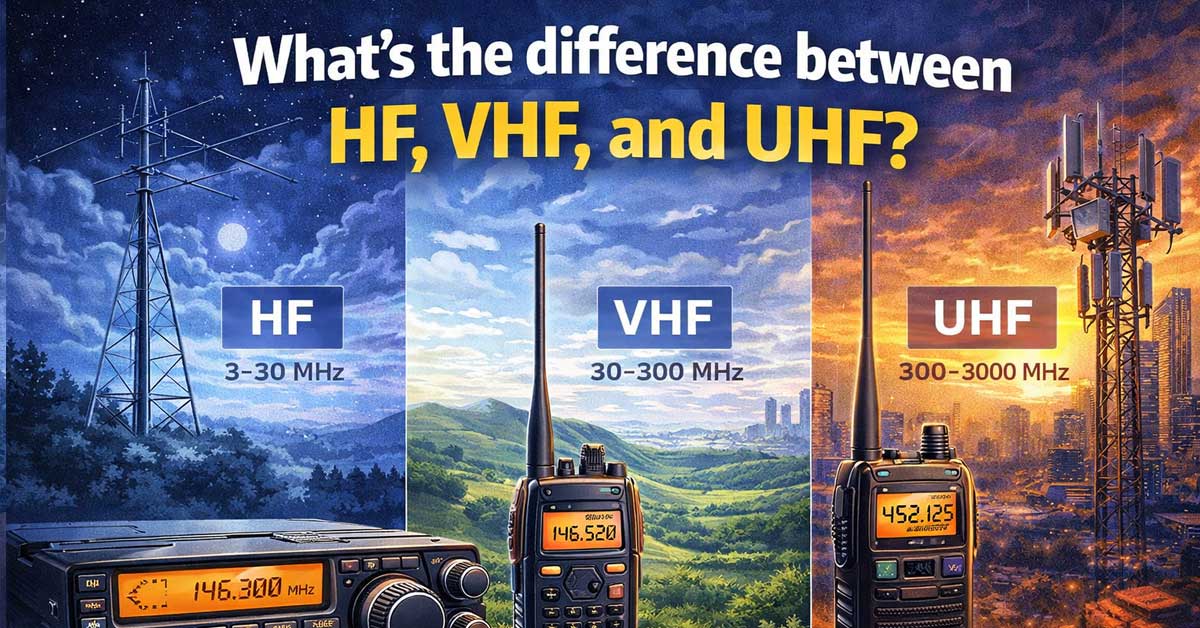
HF — High Frequency: 3 MHz to 30 MHz Despite the name, HF is actually the lower end of what most people think of as “radio.” These are the shortwave frequencies. Wavelengths range from 10 to 100 meters — physically long waves.
VHF — Very High Frequency: 30 MHz to 300 MHz The middle range. FM radio broadcasts at 88 to 108 MHz, sitting squarely in VHF. TV channels 2 through 13 were historically VHF. Aviation communication runs on VHF. Wavelengths range from 1 to 10 meters.
UHF — Ultra High Frequency: 300 MHz to 3 GHz The higher range used for most modern two-way communication. Cell phones, GPS, Wi-Fi, Bluetooth, television, and the 70cm amateur band all live in UHF territory. Wavelengths range from 10 centimeters to 1 meter.
How Each One Travels
This is the part that actually matters for practical use. The three ranges don’t just occupy different numbers on the spectrum — they travel through space in fundamentally different ways.
HF: The Long-Distance Band
HF signals have a unique property that VHF and UHF don’t share: they bounce off the ionosphere.
The ionosphere is a layer of the atmosphere from roughly 60 to 1,000 kilometers up, charged by solar radiation. HF signals transmitted at the right angle hit this layer and reflect back to Earth, landing hundreds or thousands of miles from where they originated. From there they can bounce back up to the ionosphere again and reflect once more — a process called multi-hop propagation — allowing signals to travel completely around the globe.
This is why shortwave radio stations could broadcast internationally before satellites existed. It’s why ham operators routinely hold conversations with people on other continents using equipment that fits on a desk. The ionosphere acts as a free, naturally occurring relay station covering the entire planet.
The tradeoff is that HF propagation is variable. The ionosphere changes with the time of day, the season, the 11-year solar cycle, and random atmospheric conditions. A frequency that reaches Australia reliably at noon might be useless at midnight. HF operators learn to read propagation conditions and choose their frequencies accordingly — a skill that takes time to develop.
HF signals also travel along the ground for shorter distances through what’s called ground wave propagation — useful for consistent regional coverage of up to a few hundred miles on the lower HF frequencies.
VHF: Line of Sight With Some Exceptions
VHF signals generally travel in straight lines. They don’t bend around the Earth’s curvature the way HF signals do, and they don’t bounce off the ionosphere under normal conditions. This makes VHF primarily a line-of-sight technology — you can communicate as far as the radio horizon allows, which for ground-level stations is typically 20 to 50 miles depending on terrain and antenna height.
Getting above the terrain dramatically extends VHF range. A VHF repeater on a hilltop at 3,000 feet of elevation can cover an entire county or metropolitan area because it has line of sight to everything below it. Aircraft communicate on VHF specifically because altitude gives them line of sight to ground stations across hundreds of miles.
VHF does exhibit some unusual propagation under specific atmospheric conditions — tropospheric ducting can carry VHF signals thousands of miles, and sporadic-E propagation occasionally lets VHF signals bounce off ionospheric clouds. These are exciting anomalies for ham operators but not reliable communication tools.
Buildings, hills, and terrain obstruct VHF signals more than HF but less than UHF. A VHF signal passes through moderate foliage reasonably well and handles urban environments adequately.
UHF: Short Range, High Capacity
UHF signals are the shortest of the three ranges and behave most like light — traveling in very straight lines, reflecting off hard surfaces, and being absorbed or blocked by dense materials. They don’t bend around obstacles the way lower frequencies do.
The tradeoff for shorter range is higher capacity. UHF frequencies can carry far more data than HF or VHF. This is why cell phones, Wi-Fi, and modern broadband wireless all live in UHF and above — the physics of higher frequencies allow them to carry the bandwidth that data-heavy applications require.
UHF has an interesting property in built environments: it reflects off buildings and hard surfaces, allowing signals to reach indoors and around corners through reflection rather than direct transmission. This makes it effective in urban canyons and inside buildings where VHF would struggle. Your cell phone works inside a concrete building partly because UHF signals bounce their way in through windows and gaps rather than needing a direct path.
The downside is that UHF is absorbed significantly by water — including the water in human bodies, trees, and wet foliage. Heavy vegetation and rain cause more signal loss at UHF than at lower frequencies.
Antenna Size
The physical length of an antenna is directly related to the wavelength of the signal it’s designed for. Longer wavelengths need bigger antennas. This has real practical implications.
An efficient HF antenna for the 40-meter band needs to be around 20 meters long — roughly 66 feet. For the 80-meter band, double that. This is why HF radio stations have large antenna arrays and why mobile HF installations require compromised antennas that sacrifice some performance for portability.
A VHF antenna for the 2-meter ham band needs to be about 50 centimeters — less than two feet. Manageable on a vehicle, comfortable as a handheld.
A UHF antenna for the 70cm band needs to be about 17 centimeters — small enough to fit on a handheld radio or a phone without being conspicuous.
This is why handheld radios are practical at VHF and UHF but not at HF. The physics of antenna size make a truly portable HF radio a real engineering challenge, though modern technology has produced compromise solutions.
Who Uses Each Range and Why
HF is used by:
- Ham radio operators for regional, continental, and global communication
- Shortwave broadcasters reaching international audiences
- Military and government agencies needing long-range communication without satellite dependency
- Maritime and aviation services for over-ocean communication where VHF doesn’t reach
- Emergency communication networks linking disaster zones to outside areas
VHF is used by:
- FM radio broadcasting
- Aviation communication between pilots and air traffic control
- Marine VHF radio for coastal and inland waterway communication
- Public safety agencies — police, fire, EMS — for regional coordination
- Ham radio operators for local and regional communication through repeaters
- Weather radio broadcasts
UHF is used by:
- Cell phone networks
- Wi-Fi and Bluetooth
- GPS
- Television broadcasting
- Two-way radios for business, public safety, and personal use
- Ham radio operators on the 70cm band
- Military tactical communication
Penetration Through Materials
How each range handles walls, buildings, and terrain matters significantly for practical use.
HF signals pass through most building materials without significant loss. They also diffract around hills and large obstacles more effectively than higher frequencies. This is part of why HF works for communication in varied terrain.
VHF penetrates buildings reasonably well but struggles with dense reinforced concrete and underground spaces. It handles open terrain well but is blocked by significant geographic features like mountain ranges.
UHF penetrates some building materials through reflection and diffraction but is more significantly attenuated by dense materials than lower frequencies. It’s absorbed by water, foliage, and the human body more readily than VHF. However its reflective behavior in urban environments gives it practical indoor utility that its theoretical limitations might suggest it shouldn’t have.
In the Context of Ham Radio
For ham operators specifically, the three ranges serve distinct roles that complement each other.
A Technician-class license gives access to VHF and UHF privileges primarily — the 2-meter and 70cm bands being the most popular. This is local and regional communication, mostly through repeaters. It’s where most new hams start.
A General or Extra class license opens up HF privileges, which is where the global communication capability lives. The jump from Technician to General is the jump from local radio to worldwide radio.
A complete ham station typically covers all three ranges — HF for long-distance work, VHF for local repeater use and simplex communication, UHF for local work and digital modes. Each band in the toolkit serves a scenario the others don’t cover as well.
Quick Reference
| HF | VHF | UHF | |
|---|---|---|---|
| Frequency Range | 3–30 MHz | 30–300 MHz | 300 MHz–3 GHz |
| Wavelength | 10–100 meters | 1–10 meters | 10 cm–1 meter |
| Propagation | Ionospheric skip + ground wave | Line of sight | Line of sight |
| Typical Range | Regional to global | 20–50 miles | 5–20 miles |
| Antenna Size | Large | Moderate | Small |
| Key Uses | Shortwave, global ham, maritime | FM radio, aviation, public safety | Cell phones, Wi-Fi, local two-way |
The Bottom Line
HF bounces off the ionosphere and reaches across the globe. VHF travels in straight lines and covers regions. UHF travels in very straight lines, covers shorter distances, and carries more data. Each range is dominant in the applications where its physical behavior is an advantage rather than a limitation.
The reason so many different radio services exist across these three ranges isn’t arbitrary — it’s because the physics of each range make it the right tool for specific jobs that the others can’t do as well.
The frequency determines the physics, and the physics determines what the radio is actually useful for.

Meet Ry, “TechGuru,” a 36-year-old technology enthusiast with a deep passion for tech innovations. With extensive experience, he specializes in gaming hardware and software, and has expertise in gadgets, custom PCs, and audio.
Besides writing about tech and reviewing new products, he enjoys traveling, hiking, and photography. Committed to keeping up with the latest industry trends, he aims to guide readers in making informed tech decisions.