
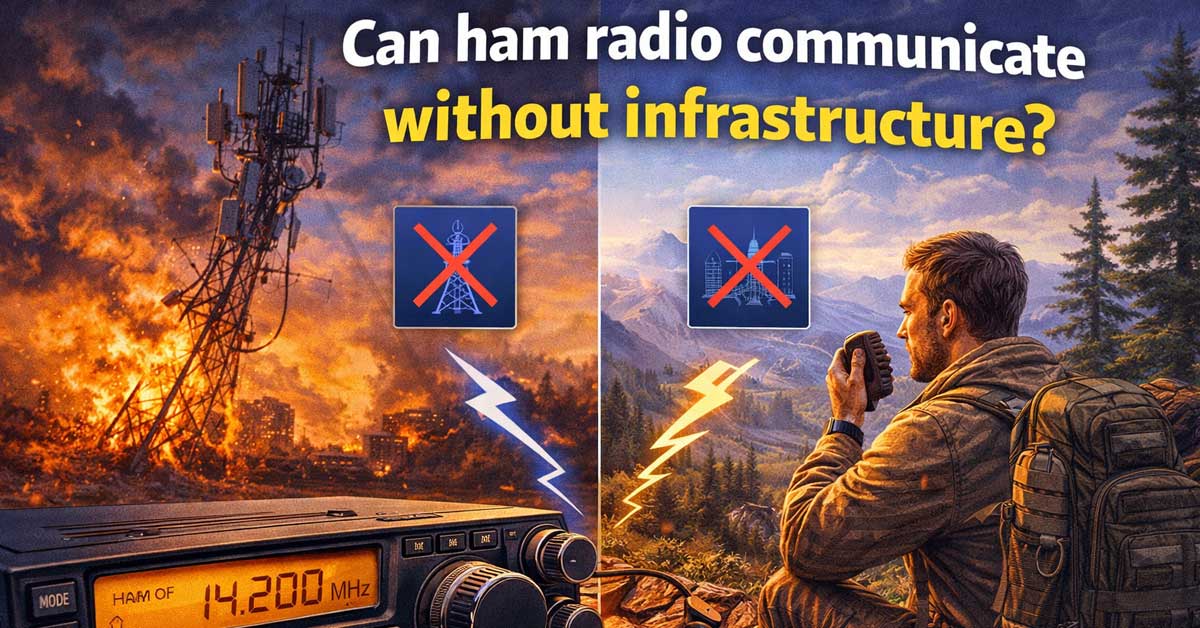

Yes — and this capability is more significant than most people outside the hobby realize
Most modern communication depends on infrastructure you don’t control and can’t fix. Your cell phone needs towers. Your internet needs fiber lines and data centers. Your VoIP phone needs both. Ham radio is one of the very few communication technologies that can operate entirely without any of this — no towers, no cables, no servers, no internet, no power grid. Here’s how that actually works and what it means in practice.
What “No Infrastructure” Actually Means
It’s worth being precise about this because the claim can sound exaggerated.
Infrastructure-dependent communication means your signal has to travel through equipment owned and maintained by a third party before it reaches its destination. A cell call leaves your phone, hits a tower, routes through a carrier’s network, hits another tower, and arrives at the other phone. Every link in that chain has to work. Any single failure breaks the connection.
Infrastructure-independent communication means your signal travels directly from your antenna to another antenna through the air. Nothing in between. No third-party equipment. No chain of dependencies to fail.
Ham radio in its most basic form — one operator transmitting directly to another on the same frequency — is exactly this. The signal leaves the antenna, propagates through space, and arrives at the receiving antenna. Full stop. There is no infrastructure between those two points.
This isn’t a special emergency mode or a backup configuration. It’s simply how radio works.
Direct Simplex Communication
Simplex means transmitting and receiving on the same frequency — the most basic form of two-way radio communication. No repeater, no relay, no internet link. Two radios, two antennas, one shared frequency.
On VHF and UHF, simplex communication covers line-of-sight distances — typically a few miles for handheld radios at ground level, potentially 20 to 50 miles or more between elevated positions or with directional antennas. In flat terrain or from hilltops, simplex VHF contacts of 100 miles or more are achievable under normal conditions.
On HF, simplex communication reaches dramatically further through ionospheric propagation. Two operators on opposite sides of a continent — or opposite sides of the planet — can communicate directly with nothing between them but physics.
The equipment required for simplex communication is minimal. A radio, a power source, and an antenna. The power source can be a battery. The antenna can be a wire. None of it requires external support to function.
What Happens to Repeaters When Infrastructure Fails
Repeaters are fixed stations that extend VHF and UHF range — they receive on one frequency and retransmit on another at higher power. Most everyday local ham communication runs through repeaters, which technically makes them a form of infrastructure.
But ham radio repeaters are fundamentally different from commercial infrastructure in one critical way: the ham community builds and maintains them specifically to survive infrastructure failures.
Well-maintained emergency-capable repeaters run on battery banks charged by solar panels, backed by generators with stored fuel. They’re designed to operate independently of the power grid for days or weeks. They’re owned and maintained by local ham clubs or individual operators who live in the community they serve — not distant corporations with quarterly profit targets.
When the grid goes down, commercial cell towers run out of backup battery in a few hours. A properly maintained ham repeater keeps running indefinitely on solar and battery power. The infrastructure exists, but it’s resilient infrastructure — designed from the ground up to stay up when everything else fails.
And critically, if the repeater does fail, operators fall back to simplex. The communication doesn’t stop — it adjusts.
HF: The Infrastructure-Free Long-Distance Solution
VHF and UHF simplex handles local communication. HF handles everything beyond that — regional, continental, and global communication without a single piece of infrastructure involved.
HF signals in the 3 to 30 MHz range bounce off the ionosphere — a naturally occurring layer of charged particles in the upper atmosphere — and return to Earth hundreds or thousands of miles from the transmitter. This happens without any human-made relay. The ionosphere is always there, always free, always functional regardless of what’s happening on the ground below.
A ham operator in a disaster zone can use an HF radio running on a car battery with a wire antenna thrown over a tree branch and establish two-way communication with operators across the country or across the ocean. No tower between them. No fiber line. No satellite. Just physics.
This is qualitatively different from any other widely available communication technology. Satellite phones come closest — they also don’t depend on ground infrastructure between endpoints — but they depend on the satellite constellation remaining operational and on the user having an active commercial subscription. HF radio depends on nothing but the ionosphere, which has been reliably doing its job for billions of years.
Mesh Networking: Building Ad-Hoc Digital Infrastructure
Beyond voice communication, ham radio operators have developed mesh networking — a technology that creates a self-healing digital communication network using ham radio frequencies with no central infrastructure.
Systems like AREDN (Amateur Radio Emergency Data Network) use modified commercial Wi-Fi hardware running on ham frequencies to create a distributed network where every node both uses and extends the network. If any node fails, traffic automatically routes around it. The network has no central point of failure because it has no center — it’s a web of peer-to-peer connections.
A deployed AREDN mesh network can carry:
- Voice over IP telephone calls
- Email and messaging
- Video from security cameras or remote sites
- File transfer
- Real-time situational awareness applications
All of this runs entirely on ham frequencies with no internet connection required. The mesh is the internet — a private, locally controlled, infrastructure-independent digital network deployed wherever operators set up nodes.
During a disaster, an AREDN mesh can connect hospitals, emergency shelters, incident command posts, and coordination centers with digital communication that functions completely independently of whether the commercial internet exists.
Store and Forward: Communication Across Time
Traditional two-way radio requires both parties to be on the air simultaneously. Store-and-forward systems remove that requirement.
Winlink is an email system that runs over ham radio frequencies. Operators compose messages on a computer, connect to the Winlink network via radio, and the message is stored on a server — which itself can be reached via ham radio — and forwarded when the recipient connects. If internet connectivity exists somewhere in the chain, messages can cross into regular email. If it doesn’t, the message travels through a chain of ham radio links until it reaches its destination.
A person in a disaster zone with no internet access can send a message via Winlink that reaches a family member’s email inbox thousands of miles away — traveling entirely through ham radio links until it reaches a Winlink gateway with internet access.
Packet radio operates similarly — digital data transmitted over ham frequencies in packets that can be stored and forwarded through a network of nodes. The technology predates the modern internet and operates completely independently of it.
Portable and Self-Powered Operation
The ability to communicate without infrastructure is only useful if the radio itself can run without infrastructure. Ham radio equipment is well suited to this.
Modern HF transceivers from manufacturers like Yaesu, Icom, and Elecraft include portable and QRP (low power) models designed specifically for field operation. Radios like the Yaesu FT-818 and various Elecraft models run comfortably on small lithium battery packs. A complete HF station capable of worldwide communication can be assembled in a backpack and run for hours on a battery that charges from a small solar panel.
VHF and UHF handhelds are even more power-efficient. A standard ham handheld radio runs on AA batteries or a small rechargeable pack. A handful of AA batteries provides hours of communication. For extended operation, a small solar panel and a battery bank keep a VHF station running indefinitely.
The combination of low power consumption, small form factor, and flexible power options makes ham radio uniquely suited to scenarios where commercial power infrastructure is unavailable. Other communication technologies require more power, more infrastructure, or both.
Real Operational Capability: What This Looks Like
To make this concrete, here’s what infrastructure-free ham radio communication actually looks like in practice:
Local scenario: Two operators in the same city communicate directly on 146.520 MHz simplex — the national VHF calling frequency. No repeater. No power grid. Handheld radios on battery power. Range: several miles at ground level, further from elevation.
Regional scenario: An operator in a disaster zone uses a portable HF radio running on a 12V battery with a wire dipole antenna to check into a regional emergency net on 7.250 MHz. Operators across a multi-state area copy the traffic. No infrastructure involved. Range: hundreds of miles.
Long-distance scenario: An operator needs to get a message outside the affected area to emergency coordinators. They use Winlink on HF to compose and send an email that travels through ham radio links to a gateway with internet access and arrives in an inbox across the country. Infrastructure used: zero, until the message reaches a gateway far outside the disaster area.
Digital network scenario: AREDN mesh nodes deployed at a hospital, an incident command post, and three shelters create a local IP network carrying voice calls and data. No internet. No carrier. No commercial infrastructure of any kind.
Limitations That Matter
Honest assessment requires acknowledging what ham radio can’t do even without infrastructure constraints.
Skilled operators are required. Equipment that nobody knows how to use provides no communication capability regardless of how infrastructure-independent it is. The value of ham radio in an emergency scales directly with the number of trained operators available and their level of preparation.
HF propagation is variable. The ionosphere that makes global communication possible also makes it unpredictable. Certain frequencies work at certain times of day and certain seasons. Solar weather affects propagation significantly. An operator who doesn’t understand propagation may find their HF radio seemingly useless when it’s actually pointed at the wrong band for the conditions.
Range on VHF simplex is limited. Without repeaters, VHF handheld communication covers miles, not counties. In mountainous terrain even that is reduced. Simplex works for close-range coordination but doesn’t replace the regional coverage a repeater network provides.
Equipment must be maintained. A radio with a dead battery, corroded connectors, or a failed antenna provides nothing. Infrastructure independence only matters if the equipment itself is operational.
Quick Summary
- Simplex communication between two ham radios requires zero infrastructure
- HF propagation via the ionosphere provides global range without any relay infrastructure
- Emergency repeaters run on solar and battery power independently of the grid
- AREDN mesh networks create infrastructure-free digital communication networks
- Winlink enables email over ham radio with no internet required at the sending end
- Portable equipment runs on batteries and solar with no connection to the power grid
- Limitations include operator skill requirements, variable HF propagation, and limited VHF simplex range
The Bottom Line
Ham radio can communicate without infrastructure — not as a workaround or an emergency fallback, but as its fundamental operating mode. Two radios and two antennas is all that’s required. Everything beyond that — repeaters, mesh networks, digital modes — adds capability and range while maintaining the core independence from third-party infrastructure that makes ham radio uniquely valuable when everything else fails.
The technology that doesn’t need infrastructure is the technology that works when infrastructure fails. That’s not a coincidence — it’s the design.
The most resilient communication system is the one that never needed anyone else’s towers to begin with.

Meet Ry, “TechGuru,” a 36-year-old technology enthusiast with a deep passion for tech innovations. With extensive experience, he specializes in gaming hardware and software, and has expertise in gadgets, custom PCs, and audio.
Besides writing about tech and reviewing new products, he enjoys traveling, hiking, and photography. Committed to keeping up with the latest industry trends, he aims to guide readers in making informed tech decisions.