
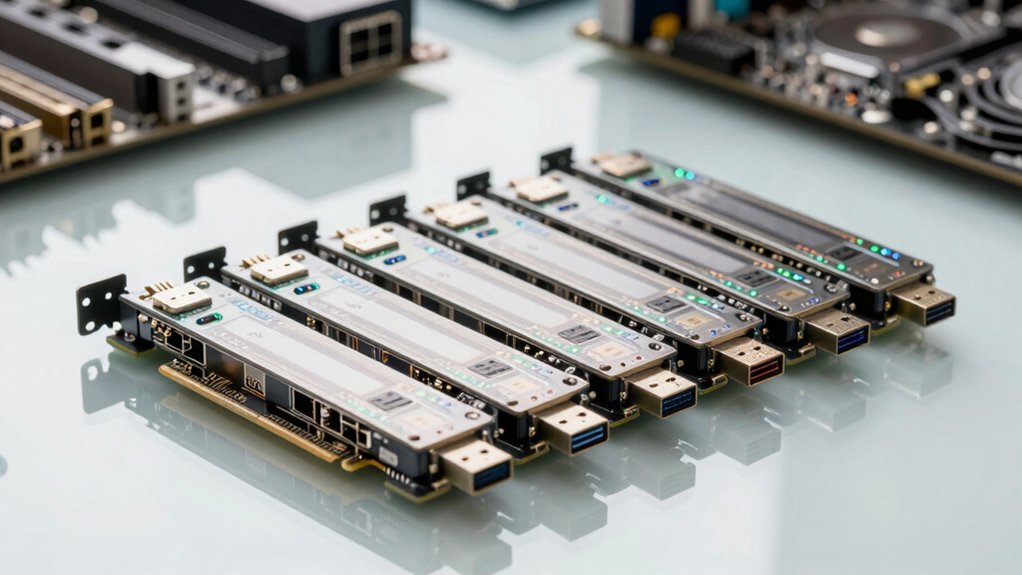

To maximize PCIe USB ports, consider these six cards: ELUTENG gives 8 ports with independent per-port power and dual interfaces for USB 3.2 Gen2 up to 10 Gbps; 7-Port Type-A/C card adds mixed ports and needs driver checks for older OS; Sinefine provides 4 ports with a built-in 12A power module and driver-light support; FS-U2S-Pro is a self-powered two-port card using a PCIe X1; GLOTREND U6A2C offers eight ports with three 5V3A groups and Linux/Windows support. For each, follow the installation steps, confirm OS compatibility, and plan for long-term maintenance; if you keep exploring, you’ll see how these fit your setup.
| ELUTENG PCIe USB 3.2 Card with 8 Ports |

| Best High-Port Count | Interface Type: PCIe to USB3 expansion card (PCIe) | USB Version Supported: USB 3.2 Gen2 (10 Gbps) | Power/Powering Model: Independent per-port power modules; no external power supply required | VIEW LATEST PRICE | Read Our Analysis |
| PCIe USB 3.0 7-Port Expansion Card (Type-A/C) |
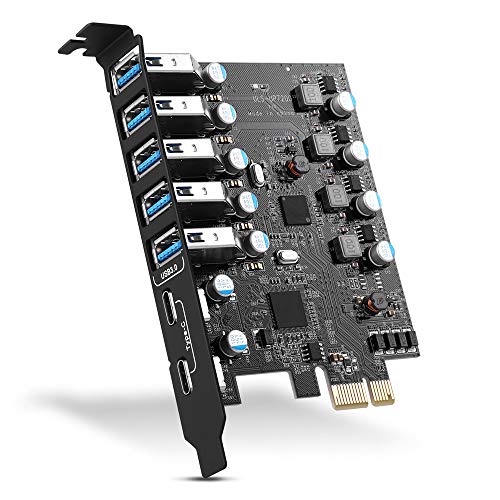
| Flexible Compatibility | Interface Type: PCIe USB 3.0 expansion card | USB Version Supported: USB 3.0 (5 Gbps) | Power/Powering Model: Self-powered (external power not mentioned) | VIEW LATEST PRICE | Read Our Analysis |
| Sinefine PCIe USB 3.0 Expansion Card (4 Ports) |
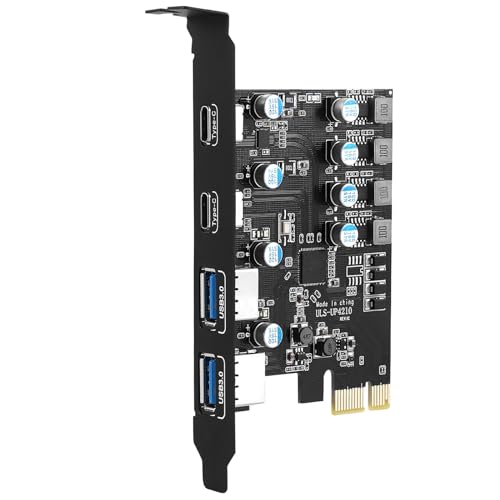
| Solid Power with 4 Ports | Interface Type: PCIe expansion card | USB Version Supported: USB 3.0 (up to 5 Gbps) | Power/Powering Model: Built-in power module; no external adapter | VIEW LATEST PRICE | Read Our Analysis |
| FS-U2S-Pro: 2-Port USB 3.0 PCIe Expansion Card Self-Powered |

| Self-Powered Reliability | Interface Type: PCIe expansion card | USB Version Supported: USB 3.0 (5 Gbps) | Power/Powering Model: Built-in self-powered technology; no extra power cable | VIEW LATEST PRICE | Read Our Analysis |
| GLOTREND U6A2C PCIe USB Expansion Card |

| High-Power Hub | Interface Type: PCI-Express x1 expansion card | USB Version Supported: USB 3.2 Gen1 (USB 3.0) (5 Gbps) | Power/Powering Model: Self-powered; no external power supply | VIEW LATEST PRICE | Read Our Analysis |
| StarTech 5-Port USB PCIe Card with USB-C |

| Enterprise-Grade Speed | Interface Type: PCIe Card | USB Version Supported: USB 3.2 (10 Gbps) | Power/Powering Model: Optional SATA power for additional current (via motherboard-derived power) | VIEW LATEST PRICE | Read Our Analysis |
More Details on Our Top Picks
ELUTENG PCIe USB 3.2 Card with 8 Ports
If you need to expand USB connections without using an extra power supply, the ELUTENG PCIe USB 3.2 Card with 8 Ports is a strong option, because it provides eight USB ports with independent power modules and dual interfaces. You install the card into a PCIe slot, then connect the two Type-A and two Type-C interfaces to devices. Each port has its own power module, supporting independent operation. The card supports USB 3.2 Gen2 for up to 10 Gbps total, with NEC control chips and solid-state capacitors for stable per-port power. It protects against faults by cutting power when needed.
- Interface Type:PCIe to USB3 expansion card (PCIe)
- USB Version Supported:USB 3.2 Gen2 (10 Gbps)
- Power/Powering Model:Independent per-port power modules; no external power supply required
- Ports Total:8 ports (6x USB-A + 2x USB-C)
- Operating System / Driver Requirements:Windows (driver not specified)
- Form Factor / Bracket Type:Standard PCIe card (full-size)
- Additional Feature:Independent per-port capacitors
- Additional Feature:Three independent power modules
- Additional Feature:Dual USB3 interfaces (A+C)
PCIe USB 3.0 7-Port Expansion Card (Type-A/C)
This 7-port PCIe USB 3.0 expansion card, featuring 5 Type-A ports and 2 USB-C ports, is ideal for users who need to maximize USB connectivity on a single PCIe slot-equipped desktop. You install it by shutting down, unplugging power, opening the case, and inserting the card into a PCIe slot, then securing it. It supports Windows, macOS, and Linux, with USB 3.0 speeds up to 5 Gbps, noting device limits. Some systems require a driver for XP/Vista/2008; newer OSes don’t. Use cases include keyboards, mice, drives, cameras, and printers; plan cable routing accordingly.
- Interface Type:PCIe USB 3.0 expansion card
- USB Version Supported:USB 3.0 (5 Gbps)
- Power/Powering Model:Self-powered (external power not mentioned)
- Ports Total:7 ports (5x USB-A + 2x USB-C)
- Operating System / Driver Requirements:Windows 10/11; Mac OS driver-free; others may require driver
- Form Factor / Bracket Type:Standard PCIe card (full-size)
- Additional Feature:7-port provisioning (5A, 2C)
- Additional Feature:Driver-free on Windows 10+
- Additional Feature:Windows XP/Vista driver pack
Sinefine PCIe USB 3.0 Expansion Card (4 Ports)
The Sinefine 4-Port PCIe USB 3.0 expansion card is a practical option when you need multiple USB connections from a single PCIe slot. You install the card in a PCI Express 1X slot, then connect up to four ports: two USB-A and two USB-C, with USB 3.0 speeds up to 5Gbps total. No external power adapter is required, but the card includes a built-in power module rated 12A total (5V, 3A per port). It supports Windows 7 through 11, Linux, and Mac OS, with no driver needed on Windows 10/11/8 and Linux. Follow the included manual for mounting screws and driver notes.
- Interface Type:PCIe expansion card
- USB Version Supported:USB 3.0 (up to 5 Gbps)
- Power/Powering Model:Built-in power module; no external adapter
- Ports Total:4 ports (2x USB-A + 2x USB-C)
- Operating System / Driver Requirements:Windows 10/11/8/ Linux; driver not needed for many
- Form Factor / Bracket Type:PCIe card (full-size)
- Additional Feature:12A total power supply
- Additional Feature:4-port protection circuitry
- Additional Feature:No external power required
FS-U2S-Pro: 2-Port USB 3.0 PCIe Expansion Card Self-Powered
FS-U2S-Pro stands out for users who need a reliable, self-powered USB 3.0 expansion via PCIe X1 without adding a separate power brick. You install the card in a PCIe X1 slot, then connect two USB-A 5Gbps ports. It uses FebSmart self-powered tech, drawing 12V from the motherboard and delivering 5V/4A total. It supports Windows, macOS, and Linux, with ASMedia ASM1042 controller for up to 5Gbps. Ensure the PC has an empty X1 slot, swap to the low-profile bracket if needed, and install drivers on older Windows versions. Test with USB 3.0 devices to verify peak speed.
- Interface Type:PCIe expansion card
- USB Version Supported:USB 3.0 (5 Gbps)
- Power/Powering Model:Built-in self-powered technology; no extra power cable
- Ports Total:2 ports (2x USB-A)
- Operating System / Driver Requirements:Windows/macOS/Linux; driver needed for older Windows
- Form Factor / Bracket Type:PCIe card (full-size with optional slim bracket)
- Additional Feature:Self-powered FebSmart tech
- Additional Feature:Low-profile/bracket option
- Additional Feature:4A total per-port capability
GLOTREND U6A2C PCIe USB Expansion Card
If you need maximum USB port density from a single PCIe slot, the GLOTREND U6A2C USB expansion card is a solid pick with eight ports in a compact X1 form factor. You install it in a PCI-Express x1 slot and rely on self-powered operation without an extra supply. It provides 8 ports: 2 USB-C and 6 USB-A, all USB 3.2 Gen 1. Bandwidth is 5Gbps shared among ports, with three power groups for 5V3A each. It supports Windows and Linux, not Mac OS. Use for up to 8 × 1A devices or 3 × 2A high-power devices as needed.
- Interface Type:PCI-Express x1 expansion card
- USB Version Supported:USB 3.2 Gen1 (USB 3.0) (5 Gbps)
- Power/Powering Model:Self-powered; no external power supply
- Ports Total:8 ports (6x USB-A + 2x USB-C)
- Operating System / Driver Requirements:Windows 11/10/8 and Server; Mac OS not supported
- Form Factor / Bracket Type:PCIe x1 card (standard/regular-profile bracket)
- Additional Feature:8 ports (6A, 2C)
- Additional Feature:5V 3A per group
- Additional Feature:Mac OS not supported
StarTech 5-Port USB PCIe Card with USB-C
If you need to expand high-speed USB-C ports on a PC or workstation, the StarTech 5-Port USB PCIe Card with USB-C stands out with four external USB‑C 10Gbps ports plus one internal USB‑A port, all powered through a PCIe x4 connection and optional SATA power. You install the card in a PCIe slot, connect SATA power if needed, and enable four external 10Gbps USB-C ports along with one internal 10Gbps USB-A port. The ASM3142 controller supports USB 3.2 up to 10Gbps. Drivers auto-install on Windows 8+, macOS, Linux.
- Interface Type:PCIe Card
- USB Version Supported:USB 3.2 (10 Gbps)
- Power/Powering Model:Optional SATA power for additional current (via motherboard-derived power)
- Ports Total:5 ports (4x USB-C + 1x USB-A internal)
- Operating System / Driver Requirements:Windows 8+; macOS/Linux; auto-install drivers on newer OS
- Form Factor / Bracket Type:PCIe card (standard profile, optional power)
- Additional Feature:4x USB-C + 1x USB-A external/internal
- Additional Feature:Optional SATA power support
- Additional Feature:10Gbps USB 3.2 via ASM3142
Factors to Consider When Choosing USB PCIe Cards
Start by listing port configurations you need, such as the number of USB ports, type (A, C), and whether you require internal headers or rear-panel access. Next, assess power delivery implications by checking total wattage, whether a powered PCIe card is needed, and if the card supports high-current devices or hubs. Finally, verify controller compatibility, installation requirements, and driver/OS support by matching chipset, confirming PCIe slot compatibility, and ensuring drivers are available for your operating system.
Port Configurations Considerations
Port configurations vary widely, so start by matching the card’s port layout to your needs. Check whether the card uses all Type-A, all Type-C, or a mix, such as 6 USB-A and 2 USB-C, or 4 ports total with 2 USB-C plus 2 USB-A. Decide if dual interfaces are useful, since some cards run USB-A and USB-C independently, letting two devices operate simultaneously without interference. Review power design per port or shared budgets, like 5V/3A per port or 5V/4A total, to prevent overload. Consider PCIe bandwidth limits; x1 slots may share up to 5–10 Gbps depending on controller and port distribution. Look for built‑in protections, such as fuses and capacitors, to safeguard high‑power devices. Choose a layout that fits your cases and devices while meeting power and speed goals.
Power Delivery Implications
What power delivery setup fits your needs, and how do you verify it before buying?
Assess whether the card uses an independent per-port power module, a self-powered design, or relies on the PCIe slot. For per-port limits, check total amperage across all ports (for example, 5V/3–4A) and per-port allowances (often 5V/2A per port). If the card is self-powered or motherboard-powered, confirm the source capacity and any voltage drop under load. Identify protections like overcurrent, per-port capacitors, and fuses, and ensure they align with your peripherals. Some cards prohibit certain devices or charging classes (e.g., BC 1.2). Verify compatibility by listing supported devices, testing scenarios, and confirming documentation covers high-power enclosures or sensors without tripping protections. Plan contingencies for fault isolation and power sequencing.
Controller Compatibility Matches
When selecting a USB PCIe card, begin by aligning the host controller with your needs. Identify the controller models (e.g., ASMedia ASM1042, NEC NEC720210/720201, ASM3142) and the speeds they manage. Check how the controller’s architecture handles per‑port power and overcurrent protection, since this determines if you need separate power modules for all ports. Review PCIe interface support and lane configurations (Gen2/3, x1/x4/x8/x16) to ensure your slot and bandwidth meet your goals. Verify driver requirements for your OS; some models offer driverless operation, others require manual drivers on older systems. Consider backward compatibility with USB 3.0/3.2 and USB 2.0/1.1, and note that performance may depend on device capabilities and bus limits. Choose a controller that balances power, speed, and compatibility.
Installation Requirements Variances
USB PCIe cards come with varying installation requirements, so start by checking slot and power needs before you buy. First, confirm PCIe slot compatibility: some cards fit only x1, while others work in x1/x4/x8/x16 slots. Next, assess power delivery: some cards are self-powered or include an additional power module, while others draw all power from the PCIe slot and require no external supply. Then verify operating-system support: some models need a Windows driver, others are plug-and-play on modern Windows, macOS, and Linux. Check bracket type: full-height versus low-profile, and plan for bracket swaps if you have a slim case. Finally, review per-port power and protection: consider per-port capacitors, overcurrent protection, and max voltages/amperage to ensure safety and compatibility.
Driver and OS Support
Determining driver and OS support is essential before buying a USB PCIe card. You should assess compatibility across Windows, Linux, and macOS before purchase. Some PCIe USB cards require drivers for older Windows versions, while Windows 10/11 and many Linux/macOS configurations may be driverless or pluggable. Check the chipset and controller, such as NEC, ASMedia, ASM1042/3142, because driver availability varies and affects plug-and-play usability. Verify cross-OS compatibility claims, since not all cards support macOS or Linux equally across models. Review driver support timelines and updates to gauge long-term compatibility with new OS releases and security patches. Decide if the card will recognize natively or needs vendor drivers and installation media, and plan accordingly.
Final Thoughts
To choose, compare port counts, bandwidth, and power needs. Start by listing your motherboard’s available PCIe slots and your total USB power requirements. If you need many ports, pick an 8‑port or 7‑port card; for fewer devices, a 4‑port or 2‑port card suffices. Check if you need Type‑A, Type‑C, or both, and whether a self‑powered card is necessary. Verify compatibility with your OS, install in PCIe x1/x4+, and route plugs accordingly. Test all devices after setup.

Meet Ry, “TechGuru,” a 36-year-old technology enthusiast with a deep passion for tech innovations. With extensive experience, he specializes in gaming hardware and software, and has expertise in gadgets, custom PCs, and audio.
Besides writing about tech and reviewing new products, he enjoys traveling, hiking, and photography. Committed to keeping up with the latest industry trends, he aims to guide readers in making informed tech decisions.