
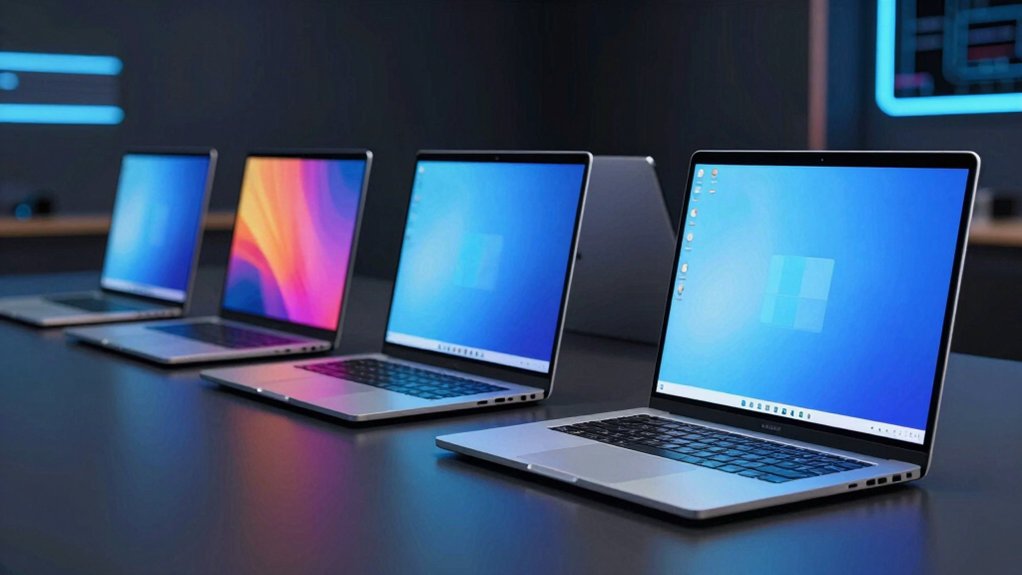

Review five Intel Core Ultra 9 laptops: HP OmniBook, Dell 16 Plus, ASUS Zenbook 14 Copilot AI, HP Omen 16, and ASUS ROG Strix G16. Compare display sizes and resolutions, RAM (32GB), storage (1–2TB), and AI features like Intel AI Boost NPU up to 13 TOPS. Check cooling and durability, then prioritize models balancing portability with performance. Assess I/O options, ports, and collaboration tools for Copilot-style workflows. If you keep reading, you’ll learn more.
| HP OmniBook Laptop: 16″ Touchscreen 32GB RAM 1TB SSD |

| Best Overall | CPU Class: Intel Core Ultra 9 (285H) | RAM Capacity: 32GB | Storage Capacity: 1TB SSD | VIEW LATEST PRICE | Read Our Analysis |
| Dell 16 Plus Laptop with 2TB SSD Arc Graphics Windows 11 |

| AI-Ready Powerhouse | CPU Class: Intel Core Ultra 9 (288V) | RAM Capacity: 32GB | Storage Capacity: 2TB SSD | VIEW LATEST PRICE | Read Our Analysis |
| ASUS Zenbook 14 Copilot AI Laptop with OLED |

| Creator’s OLED Pro | CPU Class: Intel Core Ultra 9 (285H) | RAM Capacity: 32GB | Storage Capacity: 1TB SSD | VIEW LATEST PRICE | Read Our Analysis |
| HP Omen 16″ Gaming Laptop 32GB RAM 1TB SSD |
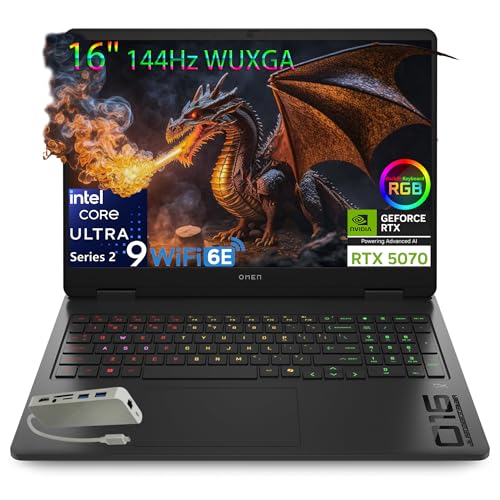
| Gaming Powerhouse | CPU Class: Intel Core Ultra 9 (285H) | RAM Capacity: 32GB | Storage Capacity: 1TB SSD | VIEW LATEST PRICE | Read Our Analysis |
| ASUS ROG Strix G16 (2025) Gaming Laptop |

| Premium All-Rounder | CPU Class: Intel Core Ultra 9 (275HX) | RAM Capacity: 32GB | Storage Capacity: 1TB SSD | VIEW LATEST PRICE | Read Our Analysis |
More Details on Our Top Picks
HP OmniBook Laptop: 16″ Touchscreen 32GB RAM 1TB SSD
This HP OmniBook laptop is the best fit if you need a ready-to-use, high-performance machine for business and productivity tasks. You power it on, verify Windows 11 Home is installed, and confirm the 16-inch, 2K touchscreen works smoothly. Next, check memory and storage: 32GB RAM and 1TB SSD ensure fast multitasking and ample space. Open essential apps, like Office 365, and test performance with large documents. Connect peripherals via USB-C and HDMI, then enable privacy shutter and microphone controls. Use the HP True Vision webcam for meetings, and keep drivers updated for reliability.
- CPU Class:Intel Core Ultra 9 (285H)
- RAM Capacity:32GB
- Storage Capacity:1TB SSD
- Display Size:16-inch
- OS Basis:Windows 11 Home
- GPU Type:Intel Arc 140T
- Additional Feature:Privacy camera shutter
- Additional Feature:100W USB-C power adapter
- Additional Feature:Enterprise-ready I/O
Dell 16 Plus Laptop with 2TB SSD Arc Graphics Windows 11
The Dell 16 Plus stands out for users who need serious AI-ready power without sacrificing portability, thanks to the Intel Core Ultra 9 288V, 32GB of memory, and a 2TB SSD paired with Arc graphics. You configure the device by noting the 16.0-inch 16:10 display, 2560×1600 resolution, and aluminum chassis. Use Windows 11 Home and Windows Hello for login. Enable AI features, manage power, and monitor cooling. Store data on the 2TB SSD and rely on Arc graphics for accelerated tasks. Update software, run security scans, and use Dell Migrate for data transfer over six months. Maintain remote support and on-site options.
- CPU Class:Intel Core Ultra 9 (288V)
- RAM Capacity:32GB
- Storage Capacity:2TB SSD
- Display Size:16.0-inch
- OS Basis:Windows 11 Home
- GPU Type:Arc graphics
- Additional Feature:Copilot key backlit
- Additional Feature:2TB SSD
- Additional Feature:Onsite 1-year support
ASUS Zenbook 14 Copilot AI Laptop with OLED
If you need top-tier performance for Creator, Business, or Professional work, the ASUS Zenbook 14 Copilot AI Laptop with OLED stands out with its Intel Core Ultra 9 Processor 285H and a built-in AI Boost NPU of up to 13 TOPS. You get 32GB LPDDR5 memory and 1TB SSD, plus Windows 11 Pro for security and productivity. Use the 14″ WUXGA OLED display for precise color and clarity, and rely on 2x Thunderbolt 4 for fast data transfer. Enable Wi‑Fi 7 and Bluetooth 5.4, then leverage the AI features and Arc graphics for demanding apps. Optimize storage, run tasks, and monitor performance.
- CPU Class:Intel Core Ultra 9 (285H)
- RAM Capacity:32GB
- Storage Capacity:1TB SSD
- Display Size:14-inch
- OS Basis:Windows 11 Pro
- GPU Type:Integrated Intel Arc 140T
- Additional Feature:OLED 14″ display
- Additional Feature:AI Boost NPU
- Additional Feature:Privacy FHD AISense camera
HP Omen 16″ Gaming Laptop 32GB RAM 1TB SSD
If you need a mobile workstation that blends gaming power with serious multitasking, the HP Omen 16” stands out with an Intel Core Ultra 9 285H processor and RTX 5070 laptop GPU, delivering bothCPU performance and AI-enabled graphics features. You get 32GB DDR5 RAM and 1TB PCIe NVMe storage for fast responsiveness. Take advantage of 8-in-1 ports for expanded connectivity, then enable Wi‑Fi 6E and Bluetooth 5.3 for reliable wireless. Use the cooling system for sustained use, and run 16″ WUXGA with 60–144Hz for smooth visuals. Install Windows 11 Home and configure Copilot+ for workflow efficiency.
- CPU Class:Intel Core Ultra 9 (285H)
- RAM Capacity:32GB
- Storage Capacity:1TB SSD
- Display Size:16-inch
- OS Basis:Windows 11 Home
- GPU Type:NVIDIA GeForce RTX 5070 Laptop
- Additional Feature:DLSS 4 AI
- Additional Feature:Tempest cooling system
- Additional Feature:4K HDMI support
ASUS ROG Strix G16 (2025) Gaming Laptop
With the ASUS ROG Strix G16 (2025) on your shortlist, you’ll want to know who benefits most from its core strengths—namely, the Intel Core Ultra 9 275HX paired with the RTX 5080 and a 16” Nebula display. You use this laptop for heavy multitasking, gaming, and content creation. Start by confirming Windows 11 Home is installed and updates are current. Check 32GB RAM for multitasking, then review the 1TB PCIe Gen4 SSD for storage needs. Use the 16:10 2.5K 240Hz display for smooth visuals, enable DLSS 4, and activate Intelligent Cooling for sustained performance. Consider Stealth Mode when in professional settings.
- CPU Class:Intel Core Ultra 9 (275HX)
- RAM Capacity:32GB
- Storage Capacity:1TB SSD
- Display Size:16-inch
- OS Basis:Windows 11 Home
- GPU Type:NVIDIA GeForce RTX 5080 Laptop
- Additional Feature:Conductonaut Extreme cooling
- Additional Feature:2.5K Nebula display
- Additional Feature:Ring RGB lightbar
Factors to Consider When Choosing Intel Core Ultra 9 Laptops
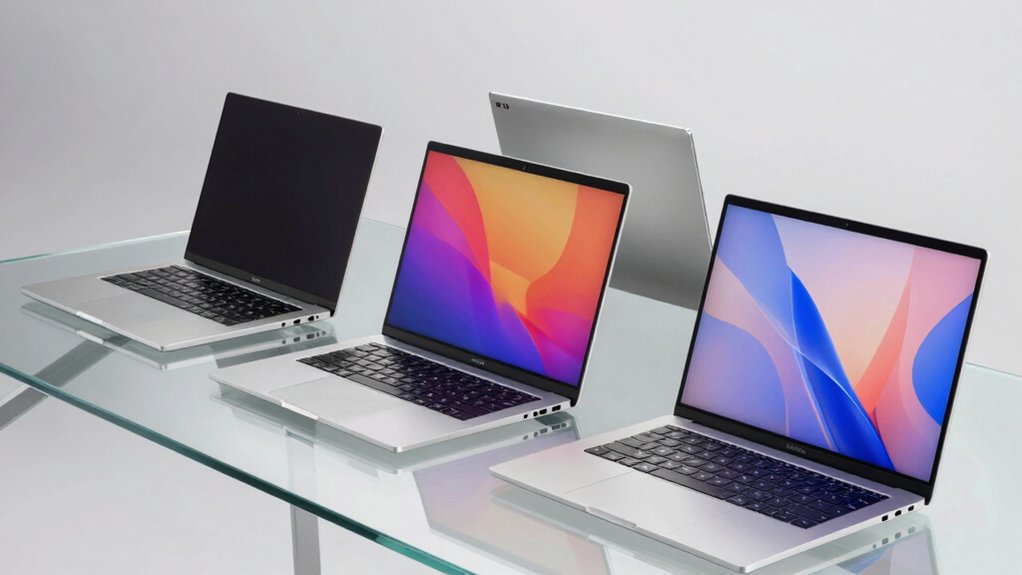
Consider how performance benchmarks and turbo modes affect real-world use, and compare CPUs on score reliability, clock speeds, and sustained performance. Evaluate power efficiency and battery life by checking Watt-hours, runtime estimates, and recharge speed, then plan for typical workloads. Assess thermal management, display quality, portability, and weight by listing design Trade-offs, screen options, panel quality, and how each model balances cooling with mobility.
Performance Benchmarks And Turbo
To evaluate performance benchmarks and turbo behavior, start by identifying the core specs that affect speed: turbo frequency, core and thread counts, cache size, memory bandwidth, and any AI acceleration features. You then compare models with up to 5.4 GHz turbo, up to 16 cores, and 16 threads to gauge peak throughput in bursts. Note the 24MB Intel Smart Cache for latency reduction during heavy workloads, and how it supports rapid data access. Examine memory bandwidth provided by DDR5 options, at 7467 MT/s or 5600 MT/s, to sustain turbo tasks. Consider AI acceleration like Intel AI Boost NPU (up to 13 TOPS) for workloads beyond raw CPU power. Use this data to rank laptops by sustained and burst performance for real‑world tasks.
Power Efficiency And Battery
Power efficiency and battery life are critical when evaluating Intel Core Ultra 9 laptops. You assess power draw by examining core counts and boost clocks, noting that speeds up to about 5.4 GHz can increase battery use under heavy workloads. Consider AI accelerators (NPUs) that offload tasks, which can reduce CPU power usage in AI-enabled apps. Look for models with advanced cooling, such as multi-fan systems or vapor chambers, because sustained performance without excessive throttling preserves battery life. Check configurations that emphasize balanced AI performance and cooler operation to extend endurance during demanding tasks. Understand workload impact: lighter tasks like web and document editing improve runtime, while gaming or AI workloads on Ultra 9 CPUs consume more power. Choose a model with a sensible balance for your typical use.
Thermal Management Design
Thermal design should prioritize sustained performance over short bursts. Start by choosing Intel Core Ultra 9 laptops with advanced cooling architectures, such as OMEN Tempest Cooling or end-to-end vapor chambers, to sustain heavy use. Look for models that use multi-fan or tri-fan configurations in gaming-oriented lines to manage peak CPU and GPU temps. Expect a balance between clock speeds (up to 5.4 GHz) and power delivery, so select systems with robust power rails and well-tinned heat paths to prevent throttling during prolonged tasks. Check for AI-based cooling features that optimize fan curves in real time, reducing noise while keeping temps in check. Verify heat dissipation paths include large chassis allowances and optimized air intake/exhaust to maintain stable temperatures.
Display Quality And Color
Display quality directly affects how you work and play on an Intel Core Ultra 9 laptop. Choose a 14–16 inch display in 2K to 2.5K resolution, such as 1920×1200 or 2560×1600, for sharp text and ample workspace. Decide between OLED and IPS panels; OLED offers vibrant colors, while IPS provides reliable color accuracy and consistency. Look for 100% DCI-P3 coverage on models aimed at creators, and consider anti-glare coatings to reduce reflections. Check brightness, aiming for 300 nits or higher to maintain readability in bright rooms. Explore HDR capabilities on select configurations to enhance contrast and color depth. Verify color profiles and calibration options, ensuring color accuracy for professional visualization work. Prioritize options that balance vivid rendering with dependable performance.
Portability And Weight
Portability and weight matter even as you chase Intel Core Ultra 9 performance. Start by noting weights vary from about 3.5 to heavier pounds due to cooling and GPU. Choose a 16-inch form factor if you need extended battery or cooling, then assess how that affects overall carry. Check display choices; Ultra 9 with high-refresh or OLED panels adds weight and thickness, so compare batteries and heat sinks before deciding. Review battery capacity and weight trade-offs, recognizing higher performance cores and GPUs demand larger cells. Examine I/O breadth—multiple USB-C/Thunderbolt and HDMI ports add to the profile, influencing portability. Weigh practical use cases, then pick a model that balances power with a comfortable, manageable size for daily transport.
AI And Copilot Features
AI features impact how you use Intel Core Ultra 9 laptops, so start by identifying what you need from AI and Copilot tools. First, verify if the model includes Intel AI Boost NPU with up to 13 TOPS; this determines performance for heavy tasks. Next, assess power and cooling; AI tasks should run reliably without thermal throttling, so confirm cooling design and 32GB RAM or more for multitasking. Then, review software integration; Copilot-style features should be embedded for collaboration and workflow, not as quick add-ons. Check memory and storage alignment with your workload, and note any AI-driven performance boosts advertised by the manufacturer. Finally, compare models on AI efficiency, like cooler operation under load, to sustain long sessions. Choose the option that balances power, efficiency, and integrated AI capabilities.
Build Quality And Durability
Start by confirming that your Intel Core Ultra 9 laptop’s chassis is built to last. You should evaluate materials first: aluminum or premium chassis indicate a rigid design. Check for high-quality materials and military-grade testing claims to gauge real-world durability. Consider form factor: slim 14–16 inch designs balance strength with portability, but verify cooling and chassis engineering to maintain integrity under load. Look at enterprise-ready claims for reliability and scalable I/O, which signal sustained performance in office environments. Note weight and thickness guidance, such as around 3.5–0.7 inches in height, to understand rigidity versus heat dissipation and portability. Compare models by these factors, testing lid rigidity, hinge durability, and chassis flex during daily use. Prioritize builds that match your expected workload and travel needs.
Final Thoughts
To choose your Intel Core Ultra 9 laptop, follow these steps: compare models by RAM, storage, and graphics; assess display quality and thermals; verify battery life and port selection; check OS and driver support; compare pricing and warranties. If you need portability, narrow to lighter ultrabooks; for gaming or workstations, prioritize GPUs and cooling. Make a short list of three options, read reviews for reliability, then pick the best value that meets your workload and budget.

Meet Ry, “TechGuru,” a 36-year-old technology enthusiast with a deep passion for tech innovations. With extensive experience, he specializes in gaming hardware and software, and has expertise in gadgets, custom PCs, and audio.
Besides writing about tech and reviewing new products, he enjoys traveling, hiking, and photography. Committed to keeping up with the latest industry trends, he aims to guide readers in making informed tech decisions.