
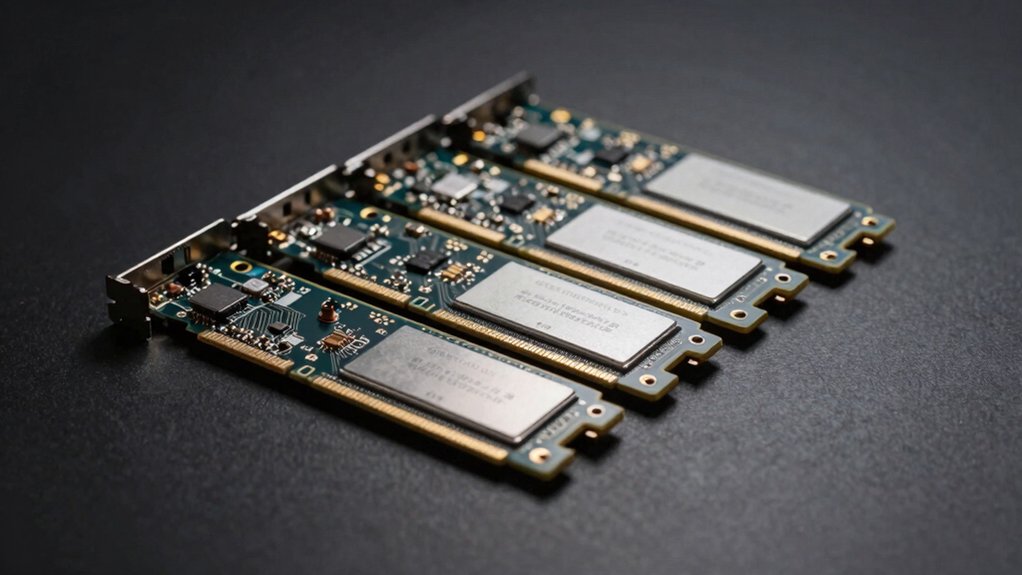

If you’re looking to boost your PC’s performance, M.2 accelerator cards offer direct upgrades for AI inference, storage speed, and processing power. You’ll find options ranging from the MX3 AI Accelerator to the ASUS Hyper M.2 x16 Card v2, each designed for specific tasks. Before you select one, you need to understand PCIe lane requirements, thermal management, and compatibility with your motherboard—details that determine whether your investment delivers real results or falls short.
| MX3 M.2 AI Accelerator |

| Best AI Performance | Primary Function: AI/computer vision acceleration | Form Factor: M.2 M-key 2280 | Operating System Support: Linux | VIEW LATEST PRICE | Read Our Analysis |
| Dual Edge TPU PCIe Adapter for Coral M.2 Accelerators |

| Dual TPU Powerhouse | Primary Function: Dual TPU AI acceleration | Form Factor: PCIe adapter card | Operating System Support: Windows, Linux | VIEW LATEST PRICE | Read Our Analysis |
| for M1037380-006 REV C PCIE FPGA m.2 Accelerator Card |

| Budget FPGA Option | Primary Function: FPGA acceleration | Form Factor: M.2 accelerator card | Operating System Support: Windows, Linux (implied) | VIEW LATEST PRICE | Read Our Analysis |
| Coral Dual Edge TPU Adapter for M.2 Accelerator |
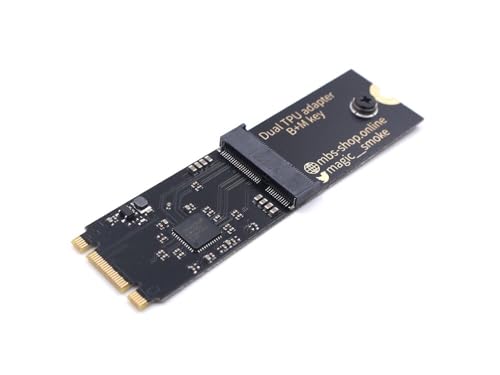
| Compact Dual Adapter | Primary Function: Dual TPU adapter/converter | Form Factor: M.2 2280 B+M Key adapter | Operating System Support: Linux (Debian-based systems) | VIEW LATEST PRICE | Read Our Analysis |
| G650-04686-01 Coral M.2 Accelerator B+M Key |

| Edge ML Leader | Primary Function: Edge TPU ML inferencing | Form Factor: M.2 2280 B+M Key | Operating System Support: Debian Linux | VIEW LATEST PRICE | Read Our Analysis |
| M2 NVME to PCI-E4.0 Accelerator Card X4 |

| NVMe Speed Boost | Primary Function: NVMe SSD to PCIe conversion | Form Factor: M.2 M-Key (2230–2280) | Operating System Support: Universal (not specified) | VIEW LATEST PRICE | Read Our Analysis |
| NGFF M.2 M-Key to PCIe X4 Expansion Card Adapter |

| Simple PCIe Converter | Primary Function: M.2 to PCIe slot expansion | Form Factor: M.2 M-Key to PCIe adapter | Operating System Support: Universal (not specified) | VIEW LATEST PRICE | Read Our Analysis |
| ASUS Hyper M.2 x16 Card v2 4 x M.2 Socket 3 |

| Maximum Storage Expansion | Primary Function: NVMe M.2 expansion (up to 4 drives) | Form Factor: PCIe x16 expansion card | Operating System Support: Universal (not specified) | VIEW LATEST PRICE | Read Our Analysis |
| NGFF M.2 to PCIe X4 Expansion Card Adapter |
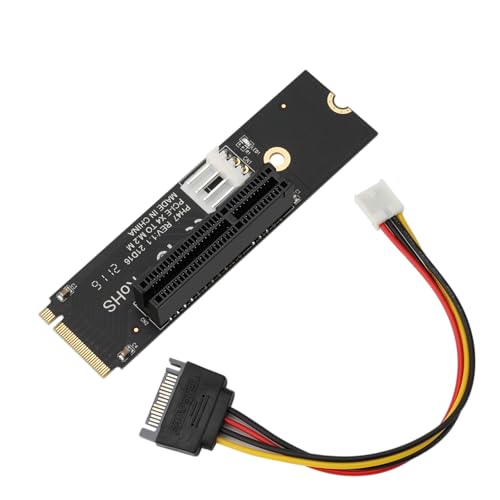
| Professional PCIe Adapter | Primary Function: M.2 to PCIe X4 conversion | Form Factor: M.2 M-Key to PCIe adapter | Operating System Support: Universal (not specified) | VIEW LATEST PRICE | Read Our Analysis |
| Coral G650 PCIe M.2 Accelerator Edge TPU |

| Most Efficient Inference | Primary Function: Edge TPU ML inferencing | Form Factor: M.2 B/M Key (22x80mm) | Operating System Support: Debian Linux | VIEW LATEST PRICE | Read Our Analysis |
More Details on Our Top Picks
MX3 M.2 AI Accelerator
Are you running AI and computer vision applications that demand specialized processing power? The MX3 M.2 AI Accelerator delivers high-performance processing in an M.2 M-key 2280 form factor. You’ll install it directly into compatible slots on your motherboard or via an M-key 2280 HAT adapter on Raspberry Pi 5. This card handles demanding computer vision workloads efficiently while consuming minimal power. The device runs on Linux operating systems, so verify your system compatibility first. You’ll access the comprehensive Software Development Kit from the MemryX developer website to streamline your AI deployment. This integration approach lets you upgrade your existing system without replacing major components.
- Primary Function:AI/computer vision acceleration
- Form Factor:M.2 M-key 2280
- Operating System Support:Linux
- PCIe Interface Type:M.2 M-key compatible
- Compatibility/Device Support:Raspberry Pi 5, Linux systems
- Software/Development Support:Comprehensive SDK, Linux support
- Additional Feature:Energy-efficient high-performance design
- Additional Feature:Comprehensive SDK included
- Additional Feature:Raspberry Pi 5 compatible
Dual Edge TPU PCIe Adapter for Coral M.2 Accelerators
If you’re running AI workloads on limited PCIe slots, the Dual Edge TPU PCIe Adapter is your solution. This PCIe Gen3 x4 splitter connects two Coral M.2 Accelerator Cards to a single slot, doubling your TPU performance for vision tasks. The adapter includes a heatsink for thermal management and works with Windows and Linux systems. It’s ideal for object detection, image classification, and real-time analytics. Install it by inserting the adapter into your PCIe x4 slot, then attach both M.2 accelerators. This approach maximizes your existing hardware investment without requiring additional slots, delivering faster ML workloads efficiently.
- Primary Function:Dual TPU AI acceleration
- Form Factor:PCIe adapter card
- Operating System Support:Windows, Linux
- PCIe Interface Type:PCIe Gen3 x4 to Gen2 x1 splitter
- Compatibility/Device Support:Coral M.2 Accelerator Cards
- Software/Development Support:TensorFlow Lite, computer vision tools
- Additional Feature:Dual TPU performance support
- Additional Feature:Integrated heatsink included
- Additional Feature:Space-efficient dual setup
for M1037380-006 REV C PCIE FPGA m.2 Accelerator Card
The M1037380-006 REV C PCIE FPGA m.2 Accelerator Card works best for users who need to boost their desktop or laptop’s computational power without replacing their entire system. This internal card installs directly into your M.2 slot and connects via PCIe interface. You’ll access removable media features for flexible hardware management. Before purchasing, confirm your device’s compatibility and available M.2 slot. Check the product warranty details through the provided link. You can report price discrepancies across online and offline retailers by signing in and submitting feedback with store location, pricing, and dates. Track price changes over time using the system’s date selectors.
- Primary Function:FPGA acceleration
- Form Factor:M.2 accelerator card
- Operating System Support:Windows, Linux (implied)
- PCIe Interface Type:PCIe interface
- Compatibility/Device Support:Desktop, Laptop
- Software/Development Support:Product warranty/support available
- Additional Feature:FPGA accelerator technology
- Additional Feature:Removable media compatible
- Additional Feature:Desktop/laptop compatible
Coral Dual Edge TPU Adapter for M.2 Accelerator
For those looking to add AI inference capabilities to desktop or laptop systems with available M.2 slots, you’ll want to contemplate the Coral Dual Edge TPU Adapter for M.2 Accelerator. This adapter fits M.2 2280 B-key or M-key PCIe slots and connects your Coral m.2 Accelerator directly to your system’s motherboard. The adapter uses one upstream x1 Gen2 PCIe lane and provides two downstream x1 Gen2 PCIe lanes for expanded connectivity. Installation requires inserting the adapter into a compatible M.2 slot and securing it with the included stainless steel mounting screw. Verify your motherboard has a PCIe-only M.2 slot before purchasing, since this adapter doesn’t work with SATA M.2 slots or external USB enclosures.
- Primary Function:Dual TPU adapter/converter
- Form Factor:M.2 2280 B+M Key adapter
- Operating System Support:Linux (Debian-based systems)
- PCIe Interface Type:PCIe x1 Gen2 (bidirectional)
- Compatibility/Device Support:M.2 2280 B-key or M-key slots (PCIe only)
- Software/Development Support:TensorFlow Lite, AutoML Vision Edge
- Additional Feature:Stainless steel mounting screw
- Additional Feature:Bidirectional upstream x1 Gen2
- Additional Feature:Dual downstream x1 lanes
G650-04686-01 Coral M.2 Accelerator B+M Key
Want to run machine learning tasks directly on your device without relying on cloud servers? The G650-04686-01 Coral M.2 Accelerator B+M Key lets you do exactly that. This M.2 module houses an Edge TPU coprocessor that delivers 4 tera-operations per second while consuming just 0.5 watts per TOPS. You’ll get efficient performance—for example, running MobileNet v2 at 400 frames per second. Install it in any compatible M.2 slot on Debian-based systems. Then compile your TensorFlow Lite models to run directly on the accelerator. You can also build custom image classification models using AutoML Vision Edge and deploy them immediately to your hardware.
- Primary Function:Edge TPU ML inferencing
- Form Factor:M.2 2280 B+M Key
- Operating System Support:Debian Linux
- PCIe Interface Type:M.2 PCIe interface
- Compatibility/Device Support:Any Debian-based system with compatible slot
- Software/Development Support:TensorFlow Lite, AutoML Vision Edge
- Additional Feature:4 TOPS performance capability
- Additional Feature:2 TOPS per watt
- Additional Feature:AutoML Vision Edge support
M2 NVME to PCI-E4.0 Accelerator Card X4
Need to boost storage performance in a 1U server or compact system? This M.2 to PCI-E4.0 converter card delivers full-speed X4 connectivity for compatible SSDs. You’ll install M.2 M-Key drives ranging from 2230 to 2280 sizes directly into your PCIe slot. The card supports industrial, automotive, and household electronics applications. High-quality components ensure reliable long-term operation. Installation requires minimal effort with included instructions. The manufacturer provides a money-back guarantee and customer support. This solution works well when you need faster storage access without replacing your entire system infrastructure.
- Primary Function:NVMe SSD to PCIe conversion
- Form Factor:M.2 M-Key (2230–2280)
- Operating System Support:Universal (not specified)
- PCIe Interface Type:PCIe 4.0 X4
- Compatibility/Device Support:1U Server, various SSDs
- Software/Development Support:Clear installation instructions
- Additional Feature:Full-speed X4 operation
- Additional Feature:1U server compatible
- Additional Feature:2230-2280 SSD support
NGFF M.2 M-Key to PCIe X4 Expansion Card Adapter
Users who’re expanding their desktop systems beyond standard slot limitations’ll find M.2 M-Key to PCIe X4 expansion cards invaluable. This adapter transforms your M.2 interface into a functional PCIe slot, enabling you to install additional hardware components directly into your system. Installation requires minimal effort: identify your M.2 slot, insert the adapter, and secure it properly. The card supports a wide range of M-Key M.2 SSDs, ensuring compatibility across different desktop configurations. Its compact design delivers high performance without consuming excessive space, making it practical for users seeking straightforward hardware expansion without complexity or technical complications.
- Primary Function:M.2 to PCIe slot expansion
- Form Factor:M.2 M-Key to PCIe adapter
- Operating System Support:Universal (not specified)
- PCIe Interface Type:PCIe X4 (supports X1, X8, X16)
- Compatibility/Device Support:Desktop PCs with PCIe slots
- Software/Development Support:Plug-and-play (no driver required)
- Additional Feature:Transforms M.2 into PCIe
- Additional Feature:Versatile desktop system support
- Additional Feature:Compact powerful design
ASUS Hyper M.2 x16 Card v2 4 x M.2 Socket 3
If you’re looking to expand your PC’s storage capacity without replacing your existing drives, the ASUS Hyper M.2 x16 Card v2 offers a straightforward solution for adding up to four NVMe M.2 drives simultaneously. This PCIe 3.0 expansion card delivers up to 128 Gbps total transfer bandwidth across its four M.2 sockets. You’ll install the card into your motherboard’s x16 slot, then populate each socket with compatible drives. The integrated blower-style fan prevents thermal throttling during intensive operations. For advanced users, Intel VROC technology support enables you to configure bootable RAID arrays using your CPU’s PCIe lanes. This setup works well if you need substantial additional storage without replacing your current drives.
- Primary Function:NVMe M.2 expansion (up to 4 drives)
- Form Factor:PCIe x16 expansion card
- Operating System Support:Universal (not specified)
- PCIe Interface Type:PCIe 3.0 x16
- Compatibility/Device Support:Systems with PCIe x16 slot
- Software/Development Support:Intel VROC technology support
- Additional Feature:Four M.2 socket support
- Additional Feature:128 Gbps total bandwidth
- Additional Feature:Integrated blower-style cooling
NGFF M.2 to PCIe X4 Expansion Card Adapter
The NGFF M.2 to PCIe X4 Expansion Card Adapter works best for builders who want to repurpose an extra M.2 slot by converting it into a standard PCIe expansion port. You’ll plug your M.2 drive into the adapter, then insert the adapter into any PCIe slot on your motherboard. The open-ended design supports X1, X8, and X16 devices, giving you flexibility with different peripherals. Installation requires no drivers for the adapter itself, though your PCIe devices may need them depending on your system. The 4-layer PCB and filter capacitors maintain signal stability during high-speed data transfers. Your actual performance depends on your M.2 interface speed, so verify compatibility before purchasing.
- Primary Function:M.2 to PCIe X4 conversion
- Form Factor:M.2 M-Key to PCIe adapter
- Operating System Support:Universal (not specified)
- PCIe Interface Type:PCIe X4
- Compatibility/Device Support:Systems with PCIe slots
- Software/Development Support:Plug-and-play (adapter), device-specific drivers may vary
- Additional Feature:4-layer PCB construction
- Additional Feature:Lateral 4-pin power connector
- Additional Feature:Status indicator lights included
Coral G650 PCIe M.2 Accelerator Edge TPU
For machine learning projects requiring efficient on-device inference, Google’s Coral G650 delivers specialized processing power without consuming excessive energy. This M.2 accelerator features an Edge TPU coprocessor that processes 4 tera-operations per second while using only 0.5 watts per TOPS. You’ll run TensorFlow Lite models at remarkable speeds—MobileNet v2 reaches 400 FPS. The card fits B/M Key slots in compatible systems and integrates with Debian-based Linux distributions. Install it into your PCIe slot, compile your TensorFlow models for Edge TPU compatibility, and deploy inference tasks locally without relying on cloud processing.
- Primary Function:Edge TPU ML inferencing
- Form Factor:M.2 B/M Key (22x80mm)
- Operating System Support:Debian Linux
- PCIe Interface Type:M.2 PCIe interface
- Compatibility/Device Support:Any Debian-based system with compatible slot
- Software/Development Support:TensorFlow Lite support
- Additional Feature:4 TOPS performance capability
- Additional Feature:0.5 watts per TOPS
- Additional Feature:MobileNet v2 at 400FPS
Factors to Consider When Choosing M.2 Accelerator Cards
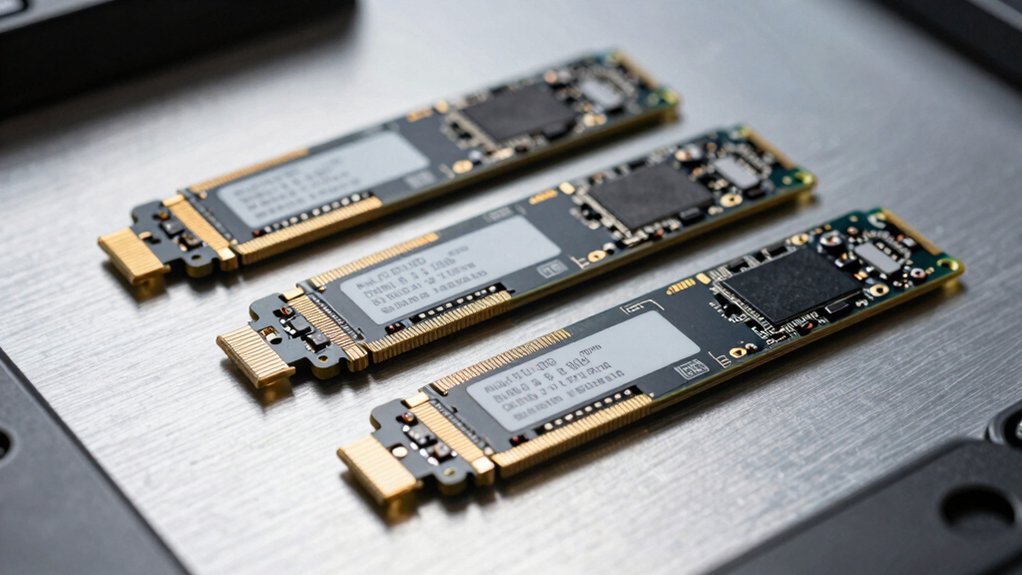
When selecting an M.2 accelerator card, you’ll need to evaluate five key factors: performance and throughput that match your workload demands, system compatibility with your motherboard and PCIe slots, power consumption efficiency to ensure your PSU can handle it, software and driver support for your operating system, and form factor considerations for physical fit and installation space. Start by checking your motherboard’s PCIe generation (Gen3, Gen4, or Gen5) and available M.2 slots, then compare the card’s specifications against your specific tasks, whether that’s machine learning, video encoding, or data processing. Finally, verify that the card’s power requirements don’t exceed your power supply’s capacity and that drivers are available for your system before purchasing.
Performance And Throughput
How do you evaluate whether an M.2 accelerator card will handle your workload? Start by checking the PCIe generation and lane configuration. An x4 interface delivers higher data transfer rates than x1 or x2 setups, making it better for demanding tasks. Next, examine the dedicated coprocessors available—Edge TPU units, for example, provide specialized performance for ML inference on images and video. Consider your throughput needs: if you require greater aggregate performance, dual or multi-card configurations substantially increase output. Finally, assess power efficiency by calculating TOPS per watt; efficient edge inference typically runs around 0.5 watts per TOPS. Verify the form factor compatibility, since M.2 2280 and key types affect bandwidth and installation feasibility.
System Compatibility Requirements
Before you purchase an M.2 accelerator card, you’ll need to verify that your motherboard has a compatible M.2 slot with the correct key type—either B-key, M-key, or B+M key—that matches your card’s interface. Next, confirm your motherboard supports the required PCIe lanes (x1, x4, x8, or x16) that your card needs for full bandwidth. Check your system’s operating system compatibility, as some cards require specific Linux or Windows support. If you’re installing multiple cards, calculate your total PCIe lane distribution to prevent bottlenecks. Finally, measure your chassis space and verify the card’s form factor fits alongside any heatsinks or mounting hardware. Consult your motherboard manual to identify available slots and their lane configurations.
Power Consumption Efficiency
Why should you care about power consumption efficiency when selecting an M.2 accelerator card? Your card’s energy use directly impacts your electricity costs and system stability. Check the card’s TOPS per watt rating—higher numbers mean better efficiency. For example, 2 TOPS per watt indicates the card delivers two trillion operations using only one watt of power. Review the per-TOPS energy metrics to compare different models fairly. Consider your power supply capacity; higher throughput demands more total power unless the card’s architecture improves efficiency. Examine thermal design features like heatsinks or active cooling, which prevent throttling that reduces sustained performance. Match the card’s power requirements to your system’s capabilities, ensuring stable operation without overheating or power delivery issues.
Software And Driver Support
Beyond optimizing your card’s power efficiency and thermal performance, you’ll also need to evaluate the software ecosystem surrounding it. Start by verifying Linux compatibility and Debian-based system support for driver integration. Next, confirm that TensorFlow Lite or other ML frameworks you’re using are officially supported by the vendor. Check whether thorough SDKs and documentation exist to simplify your development process. Review the vendor’s update schedule to ensure drivers and software receive active maintenance, keeping pace with OS changes and ML software evolution. Finally, assess how easily the accelerator integrates with your existing setup—whether that’s Raspberry Pi, PCIe adapters, or other ecosystems—to minimize additional configuration work. Strong software support directly impacts your deployment timeline and long-term usability.
Form Factor And Installation
The physical design and mounting method of an M.2 accelerator card will determine whether it’ll work with your system, so you’ll need to verify several compatibility factors before making a purchase. First, confirm your card’s keying type—M-key or B-key—matches your available slots. Next, check the form factor; most cards use M.2 2280 dimensions. Then, identify your installation method: direct insertion into an M.2 motherboard slot, a PCIe adapter (x1, x4, x8, or x16), or a dedicated HAT for single-board computers. Finally, assess thermal management by reviewing whether the card includes heatsinks or fans, especially for high-throughput applications. Verifying these factors prevents incompatibility issues and ensures proper installation.
Final Thoughts
You need to match your M.2 accelerator card to your specific needs. First, identify whether you need AI inference, storage expansion, or FPGA capabilities. Next, verify your motherboard’s PCIe slot availability and lane allocation. Then, check driver and SDK compatibility with your operating system. Finally, confirm thermal management solutions are adequate for your setup. These steps ensure you select the right card that actually works with your system.

Meet Ry, “TechGuru,” a 36-year-old technology enthusiast with a deep passion for tech innovations. With extensive experience, he specializes in gaming hardware and software, and has expertise in gadgets, custom PCs, and audio.
Besides writing about tech and reviewing new products, he enjoys traveling, hiking, and photography. Committed to keeping up with the latest industry trends, he aims to guide readers in making informed tech decisions.