
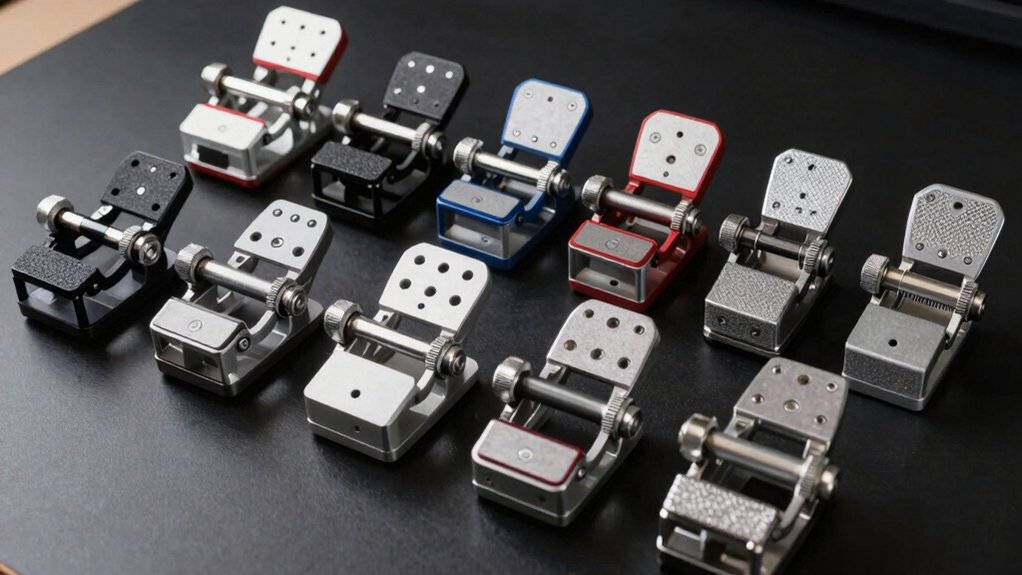

To pick the best load cell pedals, start by matching your force range and feel: consider MOZA CRP2 (200K load cell) for precision and a wide range, or FANATEC CSL Elite V2 with dual-stage load cell braking for strong feedback. Check adjustability like pedal spacing and multi-axis mounting (Logitech G RS Pedals, PRO Racing Pedals) for fit. Confirm platform compatibility and profiling software (SIMSONN MANAGER, Simjack). If you want more options and steps, you’ll learn more.
| Logitech G RS Pedals: Adjustable Modular Steel Frame |

| Best Overall | Load Cell Brake: 75 kg load cell brake | Modular/Adjustable Pedals: Adjustable pedal spacing and modular RS Clutch Module | PC Compatibility / HID or USB: USB connection for PC; Windows 10+ support | VIEW LATEST PRICE | Read Our Analysis |
| MOZA CRP2 Load Cell Pedals for Sim Racing |

| Budget Precision | Load Cell Brake: 200K load cell | Modular/Adjustable Pedals: Fully adjustable pedal dynamics; tool-free adjustment | PC Compatibility / HID or USB: USB connection; PC compatibility implied | VIEW LATEST PRICE | Read Our Analysis |
| SIMSONN PRO X Ultra Sim Racing Pedals Set |

| High-End Customization | Load Cell Brake: true load cell braking | Modular/Adjustable Pedals: Multi-dimensional adjustability; independent throttle/brake/clutch | PC Compatibility / HID or USB: Windows HID compatibility | VIEW LATEST PRICE | Read Our Analysis |
| Simjack UT Sim Racing Pedals with Load Cell Brake |

| PC-Only Excellence | Load Cell Brake: brake load-bearing part (6 mm) with load cell emphasis | Modular/Adjustable Pedals: Modular/drivable with adjustable mapping (Simjack Suite) | PC Compatibility / HID or USB: USB plug-and-play; PC support | VIEW LATEST PRICE | Read Our Analysis |
| Logitech G PRO Racing Pedals with Customizable Modules |

| Customization Champion | Load Cell Brake: 100kg load cell braking | Modular/Adjustable Pedals: Fully customizable; modular design; swappable springs | PC Compatibility / HID or USB: PC compatibility with G ecosystem | VIEW LATEST PRICE | Read Our Analysis |
| Fanatec CSL Elite Pedals V2 – 3-Pedal Set |

| Elite Build | Load Cell Brake: Up to 90 kg load cell braking | Modular/Adjustable Pedals: Configurable as two-pedal; sideways adjustability | PC Compatibility / HID or USB: RJ12 or USB connection; PC compatibility | VIEW LATEST PRICE | Read Our Analysis |
| Thrustmaster Raceline Pedals III – Modular Pedal Set |

| Modular Flexibility | Load Cell Brake: (implied) load cell option as modular (noting “Load Cell brake” expandable) | Modular/Adjustable Pedals: Modular and scalable design | PC Compatibility / HID or USB: Works with PS/Xbox/PC (Thrustmaster wheels); implies PC compatibility | VIEW LATEST PRICE | Read Our Analysis |
| Simjack UT Sim Racing Pedals with Load Cell (UT-P2) |

| Simpler Setup Master | Load Cell Brake: 200KG load cell brake | Modular/Adjustable Pedals: Fully adjustable via Simjack Manager | PC Compatibility / HID or USB: USB connection; PC only | VIEW LATEST PRICE | Read Our Analysis |
| Simjack UT Racing Pedals with Hydraulic Brake System |
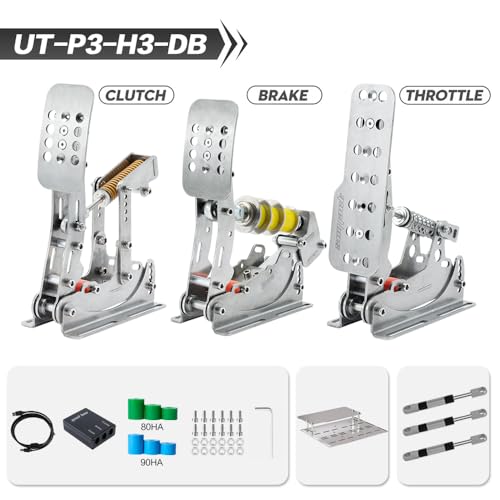
| Hydraulic Realism | Load Cell Brake: 200KG load cell braking | Modular/Adjustable Pedals: Adjustable pedal curves and tuning via Simjack | PC Compatibility / HID or USB: USB plug-and-play; PC compatibility | VIEW LATEST PRICE | Read Our Analysis |
| ASETEK SimSports La Prima Load Cell Pedals (PC) |

| Upgrade Path Elite | Load Cell Brake: not explicitly stated as load cell, but integrally described as load cell-based braking | Modular/Adjustable Pedals: Adjustable brake/throttle; interchangeable elastomers | PC Compatibility / HID or USB: PC-only; works with direct input-enabled games | VIEW LATEST PRICE | Read Our Analysis |
More Details on Our Top Picks
Logitech G RS Pedals: Adjustable Modular Steel Frame
The Logitech G RS Pedals stand out for their 75 kg load cell brake, which delivers precise, repeatable braking force for consistent trail braking and car balance. You adjust pedal spacing to suit your reach, and you extend the frame to fit your setup. Use the modular design to add the RS Clutch Pedal Module for three-pedal control, or skip it for two pedals. The steel frame provides stability with anti-tip feet, carpet grips, and wall braces. Connect via USB for PC, or direct to PRO/RS50 for consoles. Optional Racing Adapter expands wheel compatibility.
- Load Cell Brake:75 kg load cell brake
- Modular/Adjustable Pedals:Adjustable pedal spacing and modular RS Clutch Module
- PC Compatibility / HID or USB:USB connection for PC; Windows 10+ support
- Software for Curves/Profiles:Sim racing pedal profiles via RS software (RS features)
- Dual/Three-Pedal Setup:Modular three-pedal option with RS Clutch Module
- Build Durability / Materials:Steel frame; anti-tip features
- Additional Feature:Anti-tip steel frame
- Additional Feature:Direct USB PC connection
- Additional Feature:Optional RS Clutch Module
MOZA CRP2 Load Cell Pedals for Sim Racing
MOZA CRP2 Load Cell Pedals stand out for precision and versatility, making them a strong choice for serious sim racers. You install the pedals using the tool-free adjustments, then set wide-range dynamics to match your push, feel, and braking. The 200K load cell sensor provides consistent force feedback, while the 15-bit angle sensor records pedal position precisely. You can mount them inverted if needed, and customize the throttle and clutch for your setup. Use the 125 combination brake damper to fine-tune pedal stiffness, and rely on CNC aerospace-grade aluminum with a carbon fiber heel plate for durability.
- Load Cell Brake:200K load cell
- Modular/Adjustable Pedals:Fully adjustable pedal dynamics; tool-free adjustment
- PC Compatibility / HID or USB:USB connection; PC compatibility implied
- Software for Curves/Profiles:Noted for high-precision; no explicit software mentioned
- Dual/Three-Pedal Setup:Throttle and clutch independently adjustable; supports three-pedal with damper
- Build Durability / Materials:CNC aluminum; carbon fiber heel plate
- Additional Feature:Inverted mounting support
- Additional Feature:Tool-free adjustment
- Additional Feature:Wide-range adjustability
SIMSONN PRO X Ultra Sim Racing Pedals Set
Compact and precise, the SIMSONN PRO X Ultra Pedals set stands out with its robust 3MM CNC steel frame and a thickened 6mm brake load-bearing area, delivering durable, high-strength construction for repeated racing sessions. You install, adjust, and test. Use the base plate’s multi-axis adjustability to set up up, down, left, and right positions, then tune throttle, brake, and clutch independently. Engage the new damping system with 1–8 levels for smoother feedback. Configure through SIMSONN MANAGER, selecting non-linear curves and dead zones. Ensure HID compatibility, verify 16-bit axis resolution, and save profiles for consistent use across software.
- Load Cell Brake:true load cell braking
- Modular/Adjustable Pedals:Multi-dimensional adjustability; independent throttle/brake/clutch
- PC Compatibility / HID or USB:Windows HID compatibility
- Software for Curves/Profiles:SIMSONN MANAGER software; configure output curves
- Dual/Three-Pedal Setup:Throttle, brake, clutch independently adjustable
- Build Durability / Materials:High-strength steel; CNC laser-cut panels
- Additional Feature:RGB lighting effects
- Additional Feature:SIMSONN Manager curves
- Additional Feature:3-channel sampling (throttle/brake/clutch)
Simjack UT Sim Racing Pedals with Load Cell Brake
Simjack UT Sim Racing Pedals with Load Cell Brake stand out for PC-only setups needing precise braking control. You wire these USB pedals to your PC, plug and play, with no driver install required. They work with all Steam ESR stands and cockpits, on Windows 11 and earlier. Made from aluminum housing and 3 mm stainless steel with a 6 mm brake plate, they resist rust and interference. Use Simjack Manager to map non-linear curves, set dead zones, and adjust brake response. Expect 12 months warranty for the core unit and accessories. Note: not compatible with PS4/5, Xbox, or Mac.
- Load Cell Brake:brake load-bearing part (6 mm) with load cell emphasis
- Modular/Adjustable Pedals:Modular/drivable with adjustable mapping (Simjack Suite)
- PC Compatibility / HID or USB:USB plug-and-play; PC support
- Software for Curves/Profiles:Simjack Software Support; Simjack Manager
- Dual/Three-Pedal Setup:Three-channel data sampling; implies three pedals
- Build Durability / Materials:Aluminum housing; stainless steel parts
- Additional Feature:USB plug-and-play
- Additional Feature:Three-channel sampling
- Additional Feature:Simjack Manager software
Logitech G PRO Racing Pedals with Customizable Modules
The Logitech G PRO Racing Pedals with Customizable Modules stand out for their 100kg load cell braking system, which delivers precise, repeatable braking and helps you measure distance-to-stop more accurately. You adjust all three pedals, swap gas and clutch springs, and select brake elastomers to tailor feel. Use the modular design to space pedals by sliding them or remove the pedal module to suit your setup. Hall effect sensors provide contactless operation for longevity and accuracy, reducing wear. They complement PRO racing gear and the Playseat setup. Dimensions and weight are listed, with a manufacturer’s warranty available on request.
- Load Cell Brake:100kg load cell braking
- Modular/Adjustable Pedals:Fully customizable; modular design; swappable springs
- PC Compatibility / HID or USB:PC compatibility with G ecosystem
- Software for Curves/Profiles:No explicit software; hardware customization
- Dual/Three-Pedal Setup:Three pedals; modular design
- Build Durability / Materials:Durable construction; Hall sensors
- Additional Feature:Swappable gas/clutch springs
- Additional Feature:Modular pedal spacing
- Additional Feature:Hall effect sensors
Fanatec CSL Elite Pedals V2 – 3-Pedal Set
If you want precise braking and solid compatibility across platforms, the Fanatec CSL Elite Pedals V2 – 3-Pedal Set stands out for its dual-stage load cell brake and Hall-effect sensors. You install the set as a two- or three-pedal configuration, then connect it via RJ12 to Fanatec bases or use USB for PC. The brake uses a load cell with up to 90 kg measured force, while clutch and throttle use contactless Hall sensors for durability. Adjust the brake with elastomer springs (65, 75, 85 Shore) or swap to the metal spring. Attach detachable rubber covers, and align pedal position along the heel rest.
- Load Cell Brake:Up to 90 kg load cell braking
- Modular/Adjustable Pedals:Configurable as two-pedal; sideways adjustability
- PC Compatibility / HID or USB:RJ12 or USB connection; PC compatibility
- Software for Curves/Profiles:No software mentioned
- Dual/Three-Pedal Setup:Three-pedal set; adjustable
- Build Durability / Materials:All-metal; rigid steel construction
- Additional Feature:Two-pedal setup option
- Additional Feature:Detachable rubber covers
- Additional Feature:RJ12/USB direct connection
Thrustmaster Raceline Pedals III – Modular Pedal Set
For a modular setup with solid longevity, consider the Thrustmaster Raceline Pedals III if you want a scalable solution that can grow with your rig. You attach three pedals with H.E.A.R.T. sensors for precision and longevity, in an all-metal body with non-slip supports. Position each pedal using the three notches behind them to adjust pressure, and swap in the included springs to tailor feel. This modular design remains compatible with Load Cell brake when you add that component later. It works with PS5, PS4, Xbox, and PC, and with any Thrustmaster force feedback wheel.
- Load Cell Brake:(implied) load cell option as modular (noting “Load Cell brake” expandable)
- Modular/Adjustable Pedals:Modular and scalable design
- PC Compatibility / HID or USB:Works with PS/Xbox/PC (Thrustmaster wheels); implies PC compatibility
- Software for Curves/Profiles:No software mentioned; modular hardware
- Dual/Three-Pedal Setup:Three pedals; modular; load cell option available
- Build Durability / Materials:All-metal; non-slip
- Additional Feature:All-metal construction
- Additional Feature:H.E.A.R.T. sensors
- Additional Feature:Modular design (expandable)
Simjack UT Sim Racing Pedals with Load Cell (UT-P2)
Opt for the Simjack UT Sim Racing Pedals with Load Cell (UT-P2) if you want a high-force brake with precise, linear feedback and straightforward PC compatibility. You connect via USB, plug-and-play, with no driver install. It works on Windows 11 and earlier and is shipped from a USA warehouse. The unit uses a 200 KG load cell for the brake, a hydraulic/pressure sensor, and true linear input across throttle, brake, and clutch. It’s designed with aluminum housing, steel internals, and 3 mm stainless steel, plus 6 mm brake parts. Use Simjack Manager to map non-linear curves and save profiles. Readiness: PC only.
- Load Cell Brake:200KG load cell brake
- Modular/Adjustable Pedals:Fully adjustable via Simjack Manager
- PC Compatibility / HID or USB:USB connection; PC only
- Software for Curves/Profiles:SIMSONN Manager software
- Dual/Three-Pedal Setup:Three-channel sampling; implies three pedals
- Build Durability / Materials:Aluminum housing; steel framework
- Additional Feature:13.39 x 5.91 x 18.5 in dims
- Additional Feature:19.62 lb weight
- Additional Feature:12-month warranty on accessories
Simjack UT Racing Pedals with Hydraulic Brake System
This Simjack UT Racing Pedals with Hydraulic Brake System stands out for true load cell braking and hydraulic feedback, making it the best choice if you want a progressive, realistic brake feel and precise corner control. You will install the pedals on a compatible stand, connect the USB, and install the Simjack Manager Software. Next, map the pedal curves to your preference, adjust dead zones, and set brake response for each simulator. Test with a short lap, refine pressure steps, and save a profile. If needed, calibrate the 200KG load cell and hydraulic feedback for smoother travel.
- Load Cell Brake:200KG load cell braking
- Modular/Adjustable Pedals:Adjustable pedal curves and tuning via Simjack
- PC Compatibility / HID or USB:USB plug-and-play; PC compatibility
- Software for Curves/Profiles:Simjack Manager Software
- Dual/Three-Pedal Setup:Three-pedal support with hydraulic brake
- Build Durability / Materials:High-strength steel; dual-bearing
- Additional Feature:Hydraulic pressure feedback
- Additional Feature:PC-only compatibility
- Additional Feature:True Load Cell (200KG)
ASETEK SimSports La Prima Load Cell Pedals (PC)
The ASETEK SimSports La Prima Load Cell Pedals are the best choice for players who need precise braking control and durable build in PC sim racing. You set up the load cell for braking precision, then adjust pedal arms to control resistance. Use two interchangeable elastomers to change hardness and tailor feel. Install the integrated physical stop for realism, and use the expansion chamber to mimic racecar feedback. The pedals use die-cast aluminum, withstand 440 pounds of force, and endure up to 1,000,000 activations. They are PC-only, compatible with major titles, and upgradeable to Forte via the Invicta kit.
- Load Cell Brake:not explicitly stated as load cell, but integrally described as load cell-based braking
- Modular/Adjustable Pedals:Adjustable brake/throttle; interchangeable elastomers
- PC Compatibility / HID or USB:PC-only; works with direct input-enabled games
- Software for Curves/Profiles:upgrade to Forte via La Prima; no explicit pedal curve software
- Dual/Three-Pedal Setup:Three-pedal configuration; adjustable arms
- Build Durability / Materials:Die-cast aluminum; durability standards
- Additional Feature:440 lb force endurance
- Additional Feature:Upgrade path to Forte/Invicta
- Additional Feature:Expansion elastomer options
Factors to Consider When Choosing Load Cell Pedals for Sim Racing
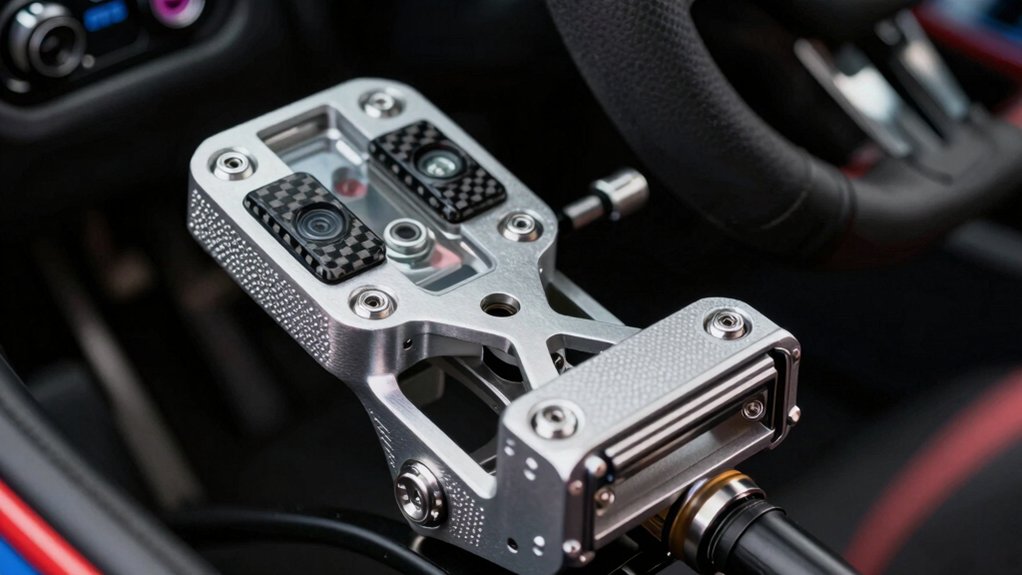
When choosing load cell pedals, assess Load Cell Sensitivity Range to ensure it matches your braking feel and adjustability, then review Pedal Adjustability Options for travel, resistance, and pedal angle to fit your stance. Evaluate Build Durability Factors for materials and mount stability, compare Sensor Technology Variants for strain gauge vs. other approaches, and confirm Compatibility And Ecosystem with your sim rig and software. Finally, compare practical steps and examples, like setting pressure ranges, adjusting pads, and verifying pedal compatibility across titles and peripherals.
Load Cell Sensitivity Range
Assessing load cell sensitivity range starts with matching your braking style to the sensor’s upper and lower limits. You measure how pedal force maps to input, then choose a range that fits your taps from light to heavy. Higher capacity load cells (100 kg+), when used, prevent saturation and keep linear response at strong braking. A broader sensitivity range often requires high-resolution sensing, such as 16-bit or higher ADC, to preserve detail across travel. Be aware that progressive or non-linear responses shift where braking begins and how it feels, so test for early or late activation. Consistency matters; check factory tolerances and calibrate across units to ensure repeatable lap times. Select a range that matches your typical braking force and tolerance for linearity.
Pedal Adjustability Options
Adjustability options matter because they let you fine-tune reach, comfort, and pedal feel for your body and setup. Start with pedal spacing and frame length to fit leg length and driving style. Then check multi-axis adjustability to set throttle, brake, and clutch positions independently, plus pedal height, angle, travel distance, and force curves. Look for tool-free or easy-access adjustments like quick-release clamps, spacers, and elastomer options to fine-tune without taking the rig apart. Consider inverted mounting and slide or pivot adjustments to suit your rig configuration and seating position. Inspect damping and spring choices, including elastomer hardness, hydraulic resistance, or load cell feel, to tailor brake and pedal response for different vehicles. Test each option in your space and document the exact settings you use.
Build Durability Factors
Durability matters because it determines how long your load cell pedals will keep giving precise input under heavy use. To build resilience, choose a rugged frame in steel or aluminum with reinforced brake components, such as 3–6 mm thick plates. Verify high-performance load cells in the 100–200 kg range and thick brake load-bearing parts to maintain braking consistency under heavy force. Ensure a multi-channel, three-pedal design with precise sensor integration for throttle, brake, and clutch to prevent flex and preserve accuracy during aggressive driving. Favor models with anti-slip bases—rubber feet, carpet grips, or wall braces—to stop movement in intense sessions. Check long-term durability features like redundant sensing hardware, tested activation cycles (1,000,000+).
Sensor Technology Variants
Sensor technology variants offer varied ways to capture pedal input precisely. You should know load cell pedals convert pedal force into an electrical signal rated in kilograms or newtons for proportional braking input. Some pedals integrate true linear input with high-resolution ADCs, such as 16-bit, to preserve subtle changes in braking force and throttle position. Variants include 200K–200+ kg load cells for a progressive braking feel, providing higher sensitivity and a wider force range than lower-kilogram options. Hybrid systems combine load cells with additional sensing, like Hall effect for throttle, delivering contactless input and durable performance. Multi-channel processing units and differential signal amplification enhance signal integrity and reduce interference from other sim rig components. Use these options to select the best match for your setup.
Compatibility And Ecosystem
Start by checking compatibility with your current setup. Confirm the pedals work with your wheel base and platform (PC, PS5/PS4, Xbox) and note whether adapters or direct USB/RJ12 connections are required. Determine if the ecosystem allows cross-compatibility or if you must stay within a brand’s wheels or cockpits to operate correctly. Verify integration with software managers like SIMS or Simjack Manager for profiling, dead zones, and brake curves. Check whether the pedals support multi-brand stand-alone use or lock into a specific wheel ecosystem, which affects future upgrades. Consider external hardware like load cell brake and hall sensors, and whether these align with your consoles and PC software ecosystem for seamless operation. Plan your purchase around compatibility and ecosystem needs.
Installation And Setup Pros/Cons
Installation can go smoothly if you plan the setup step by step. Many sets include adjustable frames or spacings and wall braces to secure stability during installation, so measure your rig first. Some pedals offer tool-free adjustment and inverted mounting to fit different configurations quickly, then test fit and secure. USB or RJ12 connections enable plug-and-play setup with compatible bases or wheels, reducing driver installation needs; connect, power, and verify. Three-channel sampling (throttle, brake, clutch) and multi-point calibration require careful alignment during mounting for accurate inputs; block the pedal to the frame, level each axis, and perform calibration. Included mounting hardware, extenders, spacers, and compatibility notes vary, so review what comes with your kit and plan adapters as needed.
Final Thoughts
To choose, compare pedal sets by stiffness, adjustability, and build quality; check compatibility with your simulator and mount points. If you want precision, pick load cell or hydraulic brakes for consistent input, and verify travel distance. For budget, start with modular Logitech G or SIMSONN options, then consider UT or ASETEK for higher-end feel. Follow setup steps: mount securely, calibrate sensitivity, test braking force, and adjust pedal positions. Select the model that matches your rig and practice routine.

Meet Ry, “TechGuru,” a 36-year-old technology enthusiast with a deep passion for tech innovations. With extensive experience, he specializes in gaming hardware and software, and has expertise in gadgets, custom PCs, and audio.
Besides writing about tech and reviewing new products, he enjoys traveling, hiking, and photography. Committed to keeping up with the latest industry trends, he aims to guide readers in making informed tech decisions.