
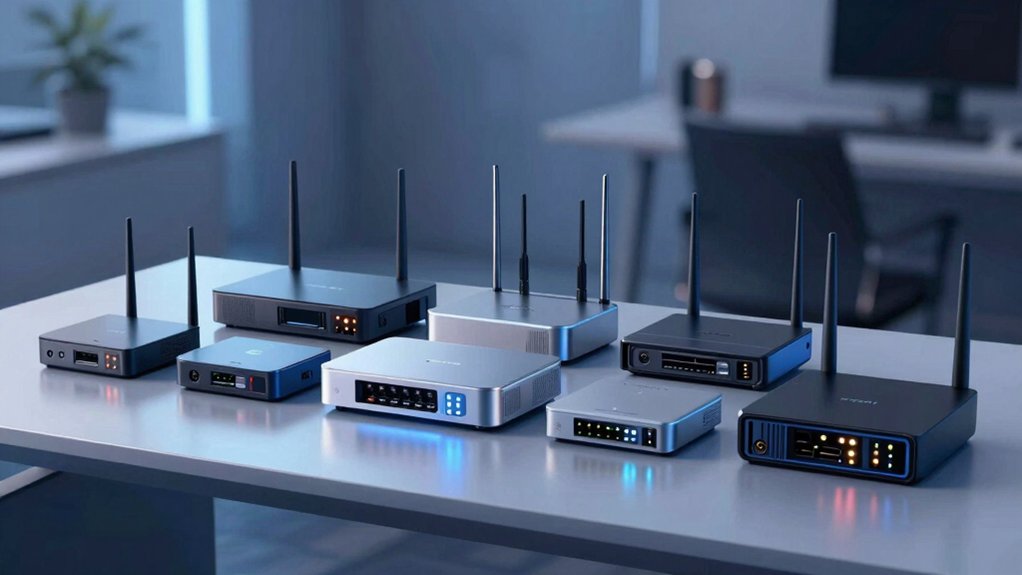

You need a WiFi router that handles VLAN segmentation, manages multi-device networks, and supports VPN routing—but choosing the right model requires understanding key features like 802.1Q tagging, centralized management, and per-VLAN firewall control. We’ve identified ten routers that network professionals rely on for these capabilities. Here’s what separates the best options from standard models.
| TP-Link AX1800 WiFi 6 Router (Archer AX21 V5) |

| Budget-Friendly Pick | WiFi Standard: WiFi 6 (802.11ax) | VPN Support: VPN Server (OpenVPN, PPTP) | Gigabit Ethernet Ports: 5 ports (Gigabit) | VIEW LATEST PRICE | Read Our Analysis |
| TP-Link ER605 V2 Gigabit VPN Router |

| Professional Grade | WiFi Standard: Wired Gigabit (no WiFi) | VPN Support: IPsec, OpenVPN, L2TP, PPTP (20/16/16/16 connections) | Gigabit Ethernet Ports: 5 ports (all Gigabit: 1 WAN, 2 WAN/LAN, 2 LAN, 1 USB WAN) | VIEW LATEST PRICE | Read Our Analysis |
| PW-AX1800 WiFi 6 Router with VPN Support |
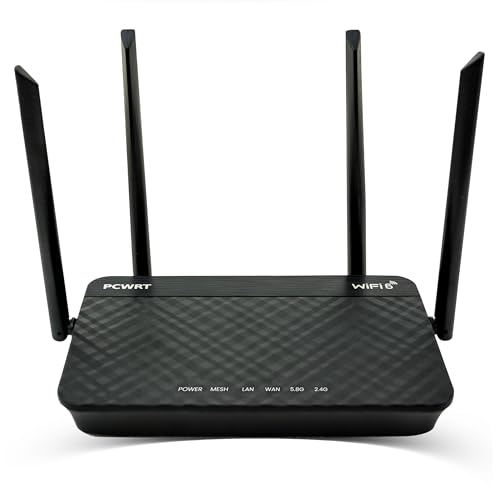
| Best for VLANs | WiFi Standard: WiFi 6 (802.11ax) | VPN Support: OpenVPN, IPsec, WireGuard (Client & Server) | Gigabit Ethernet Ports: 4 LAN ports (Gigabit) | VIEW LATEST PRICE | Read Our Analysis |
| TP-Link BE6500 WiFi 7 Router (BE400) |

| Future-Ready Performance | WiFi Standard: WiFi 7 | VPN Support: VPN Client/Server Support | Gigabit Ethernet Ports: 5 ports (1x 2.5G WAN/LAN, 1x 2.5G LAN, 3x 1G LAN) | VIEW LATEST PRICE | Read Our Analysis |
| Synology WRX560 Dual-Band Wi-Fi 6 Router |

| Best Balance | WiFi Standard: WiFi 6 | VPN Support: VPN Support | Gigabit Ethernet Ports: 5 ports (2.5GbE WAN/LAN) | VIEW LATEST PRICE | Read Our Analysis |
| NETGEAR Nighthawk WiFi 7 Router (BE9300) |

| Most Powerful | WiFi Standard: WiFi 7 | VPN Support: Not specified | Gigabit Ethernet Ports: Multiple ports (2.5G WAN/LAN port) | VIEW LATEST PRICE | Read Our Analysis |
| ASUS RT-BE88U WiFi 7 AiMesh Router |

| Enterprise-Class Speed | WiFi Standard: WiFi 7 | VPN Support: VPN Support, Site-to-Site VPN | Gigabit Ethernet Ports: 10 ports (1x 10G SFP+, 1x 10G WAN/LAN, 4x 2.5G, 4x 1G) | VIEW LATEST PRICE | Read Our Analysis |
| ASUS ExpertWiFi EBR63 AX3000 WiFi 6 Business Router |

| Business-Focused Solution | WiFi Standard: WiFi 6 (802.11ax) | VPN Support: VPN Support | Gigabit Ethernet Ports: 5 LAN ports | VIEW LATEST PRICE | Read Our Analysis |
| TP-Link AXE5400 WiFi 6E Router (Archer AXE75) |

| Editor’s Choice | WiFi Standard: WiFi 6E | VPN Support: VPN Server & Client (OpenVPN, PPTP, L2TP) | Gigabit Ethernet Ports: 5 ports (WAN/LAN support) | VIEW LATEST PRICE | Read Our Analysis |
| GL.iNet GL-BE9300 Tri-Band WiFi 7 Router |

| Best Coverage | WiFi Standard: WiFi 7 | VPN Support: OpenVPN & WireGuard (up to 680 Mbps) | Gigabit Ethernet Ports: 5 ports (5x 2.5G) | VIEW LATEST PRICE | Read Our Analysis |
More Details on Our Top Picks
TP-Link AX1800 WiFi 6 Router (Archer AX21 V5)
The TP-Link AX1800 WiFi 6 Router (Archer AX21 V5) stands out as the budget-friendly pick for small to medium networks seeking reliable VLAN support without premium costs. You get Wi-Fi 6 technology delivering up to 1.8 Gbps across dual bands, with OFDMA enabling simultaneous communication across multiple devices. The router includes four high-gain antennas and beamforming to extend coverage throughout your space. Setup requires connecting your modem via Ethernet, then configuring networks through the Tether app. You’ll access security features including WPA3 encryption and a VPN server for protected connections. TP-Link’s 24/7 technical support and two-year warranty ensure ongoing reliability for your network infrastructure.
- WiFi Standard:WiFi 6 (802.11ax)
- VPN Support:VPN Server (OpenVPN, PPTP)
- Gigabit Ethernet Ports:5 ports (Gigabit)
- Security Protocols:WPA/WPA2/WPA3
- Parental Controls:Parental Controls (basic)
- Antennas:4 High-Gain Antennas
- Additional Feature:Alexa smart home compatibility
- Additional Feature:Easy Mesh setup support
- Additional Feature:Advanced beamforming technology
TP-Link ER605 V2 Gigabit VPN Router
Need a professional-grade router that handles multiple internet connections without sacrificing security? The ER605 V2 delivers. You get five Gigabit ports—one dedicated WAN, two flexible WAN/LAN ports, and two LAN ports—plus a USB WAN slot for 4G/3G mobile broadband. This setup lets you load-balance traffic across connections seamlessly. On security, you’re covered with SPI Firewall, DoS defense, and IP/MAC/URL filtering. For VPN, you can run up to 20 LAN-to-LAN IPsec tunnels, 16 OpenVPN connections, and 16 L2TP or PPTP tunnels simultaneously. Omada SDN integration gives you centralized network management. The five-year warranty and compact design (6.22″ × 3.98″ × 0.98″) make it practical for office deployment.
- WiFi Standard:Wired Gigabit (no WiFi)
- VPN Support:IPsec, OpenVPN, L2TP, PPTP (20/16/16/16 connections)
- Gigabit Ethernet Ports:5 ports (all Gigabit: 1 WAN, 2 WAN/LAN, 2 LAN, 1 USB WAN)
- Security Protocols:SPI Firewall, DoS Defense, IP/MAC/URL Filtering
- Parental Controls:Not specified
- Antennas:Not specified
- Additional Feature:Multi-WAN load balancing
- Additional Feature:USB mobile broadband support
- Additional Feature:Lightning surge protection
PW-AX1800 WiFi 6 Router with VPN Support
Want to segment your network without complicated manual configuration? The PW-AX1800 gives you five preconfigured VLANs that isolate IoT, guest, and work networks automatically. You’ll assign each LAN port and WiFi SSID to a specific VLAN, then control traffic flow between them. The router supports dual VPN clients—OpenVPN, IPsec, and WireGuard—letting you route selected VLANs through VPN while others use your ISP connection. You get WiFi 6 on both 2.4GHz and 5GHz bands with mesh coverage eliminating dead zones. Parental controls use OpenDNS, CleanBrowsing, or Cloudflare with custom block lists and schedules. Network-wide ad blocking and encrypted DNS protect all devices simultaneously.
- WiFi Standard:WiFi 6 (802.11ax)
- VPN Support:OpenVPN, IPsec, WireGuard (Client & Server)
- Gigabit Ethernet Ports:4 LAN ports (Gigabit)
- Security Protocols:WPA2/WPA3, Ad Blocking, Encrypted DNS
- Parental Controls:OpenDNS, CleanBrowsing, Cloudflare with Custom Lists
- Antennas:4 Antennas
- Additional Feature:Five preconfigured VLANs
- Additional Feature:Network-wide ad blocking
- Additional Feature:Dual VPN client/server
TP-Link BE6500 WiFi 7 Router (BE400)
TP-Link’s BE6500 delivers future-ready performance through Wi-Fi 7 technology—but who benefits most from this router’s advanced capabilities? Remote workers, gamers, and students gain from its 5764 Mbps 5GHz speed and support for 90 simultaneous devices across 2,400 square feet. The 2.5 Gbps wired ports integrate seamlessly with gigaplus modems. You’ll access comprehensive network security through HomeShield, which includes parental controls and real-time IoT protection. EasyMesh compatibility lets you expand coverage by pairing with compatible extenders. Setup occurs through the Tether app or web interface. For enterprise-level needs, you get VPN client/server support enabling remote access while maintaining simultaneous regular internet connections.
- WiFi Standard:WiFi 7
- VPN Support:VPN Client/Server Support
- Gigabit Ethernet Ports:5 ports (1x 2.5G WAN/LAN, 1x 2.5G LAN, 3x 1G LAN)
- Security Protocols:TP-Link HomeShield, Advanced Security Core
- Parental Controls:TP-Link HomeShield Parental Controls
- Antennas:6 High-Performance Antennas
- Additional Feature:Multi-Link Operation technology
- Additional Feature:Ultra-fast 2.5 Gbps wired
- Additional Feature:Supports 90+ devices
Synology WRX560 Dual-Band Wi-Fi 6 Router
The Synology WRX560 strikes the right equilibrium between advanced networking capabilities and user-friendly management for households and home offices that need reliable VLAN segmentation. You’ll access WPA3 security, threat prevention, and firewall features through the intuitive Synology Router Manager OS. The router handles up to 150 connected devices across its dual-band Wi-Fi 6 network, delivering 3 Gbps wireless speeds. Its 2.5Gbps Ethernet port supports high-speed connections, while VLAN-based segmentation lets you isolate network traffic for security. You can manage settings via the DS router app on your mobile device. Parental controls provide additional household oversight. The mesh-ready design allows you to extend coverage when needed.
- WiFi Standard:WiFi 6
- VPN Support:VPN Support
- Gigabit Ethernet Ports:5 ports (2.5GbE WAN/LAN)
- Security Protocols:WPA3, Threat Prevention, Firewall
- Parental Controls:Parental Controls
- Antennas:2 Antennas (internal)
- Additional Feature:Multiple SSID configuration
- Additional Feature:150 connected devices max
- Additional Feature:2.5GbE WAN/LAN port
NETGEAR Nighthawk WiFi 7 Router (BE9300)
NETGEAR’s most powerful Nighthawk WiFi 7 router delivers 9.3Gbps wireless speeds—2.4 times faster than WiFi 6—making it ideal for network professionals who need robust performance across large spaces. You’ll get tri-band coverage for up to 2,500 square feet and support for 100 devices simultaneously. The 2.5 Gigabit internet port handles multi-gig speeds, while the sleek design fits any environment. You’ll need a separate cable modem since this is router-only equipment. The Nighthawk app simplifies setup and management, and NETGEAR Armor provides built-in security with a 30-day trial included.
- WiFi Standard:WiFi 7
- VPN Support:Not specified
- Gigabit Ethernet Ports:Multiple ports (2.5G WAN/LAN port)
- Security Protocols:Built-in Security, NETGEAR Armor Suite
- Parental Controls:Parental Controls
- Antennas:Not specified
- Additional Feature:Tri-band WiFi 7 design
- Additional Feature:2,500 sq. ft. coverage
- Additional Feature:NETGEAR Armor security suite
ASUS RT-BE88U WiFi 7 AiMesh Router
ASUS RT-BE88U delivers enterprise-class speed for network administrators who need reliable, high-capacity connectivity across multiple sites and devices. You’ll access 7200 Mbps WiFi 7 performance with dual 10G ports—one SFP+ and one WAN/LAN—plus four 2.5G ports for flexible network scaling. The quad-core processor handles AiMesh expansion across your entire property. Deploy site-to-site VPN for connecting remote locations securely. Configure up to five SSIDs with Guest Network Pro for departmental separation. Use AiProtection Pro powered by Trend Micro for network threat detection. The integrated parental controls and one-tap security scanning streamline administrative tasks.
- WiFi Standard:WiFi 7
- VPN Support:VPN Support, Site-to-Site VPN
- Gigabit Ethernet Ports:10 ports (1x 10G SFP+, 1x 10G WAN/LAN, 4x 2.5G, 4x 1G)
- Security Protocols:AiProtection Pro (Trend Micro), One-Tap Security Scanning
- Parental Controls:Parental Controls Integrated
- Antennas:Multiple Ports (no antenna count specified)
- Additional Feature:10G SFP+ port connectivity
- Additional Feature:34G wired capacity
- Additional Feature:Site-to-site VPN support
ASUS ExpertWiFi EBR63 AX3000 WiFi 6 Business Router
Looking for a business-focused solution that delivers VLAN support without unnecessary complexity? The ASUS ExpertWiFi EBR63 gives you enterprise-grade security with VLAN capabilities scaled for small to mid-sized networks. You’ll configure five separate SSIDs for different device priorities and user groups. The router supports WPA3-Personal and WPA2-Enterprise security protocols, protecting your network traffic. You can manage it through the ExpertWiFi app or web interface, then expand your setup using AiMesh technology when you need coverage growth. Built-in parental controls and QoS tools let you allocate bandwidth by department or function. With three-year warranty coverage and AiProtection Pro included, you’re handling security and network separation efficiently.
- WiFi Standard:WiFi 6 (802.11ax)
- VPN Support:VPN Support
- Gigabit Ethernet Ports:5 LAN ports
- Security Protocols:WPA2-Enterprise/WPA3-Personal, AiProtection Pro
- Parental Controls:Parental Controls, QoS
- Antennas:4 Antennas
- Additional Feature:Custom Guest Portal branding
- Additional Feature:Five separate SSIDs
- Additional Feature:SDN remote management
TP-Link AXE5400 WiFi 6E Router (Archer AXE75)
The TP-Link Archer AXE75 delivers tri-band WiFi 6E performance that’s earned PCMag’s 2025 Editors’ Choice recognition. This router transmits up to 5400 Mbps across three bands: 2402 Mbps on 6 GHz, 2402 Mbps on 5 GHz, and 574 Mbps on 2.4 GHz. You’ll benefit from the new 6 GHz band’s expanded bandwidth and reduced latency for gaming and streaming. The quad-core CPU and OFDMA technology enable multiple simultaneous device transmissions. For network management, you get VPN support, WPA3 security, and TP-Link HomeShield protection. Eight antennas and five ports provide robust connectivity options. OneMesh compatibility lets you extend coverage throughout your home using TP-Link extenders.
- WiFi Standard:WiFi 6E
- VPN Support:VPN Server & Client (OpenVPN, PPTP, L2TP)
- Gigabit Ethernet Ports:5 ports (WAN/LAN support)
- Security Protocols:WPA3/WPA2/WPA2-Enterprise, TP-Link HomeShield
- Parental Controls:Basic Parental Controls (free tier)
- Antennas:8 Antennas
- Additional Feature:6GHz band utilization
- Additional Feature:OneMesh whole-home coverage
- Additional Feature:PCMag Editors’ Choice award
GL.iNet GL-BE9300 Tri-Band WiFi 7 Router
Need superior coverage spanning 2,000 square feet with enterprise-grade networking? The GL-BE9300 delivers WiFi 7 speeds up to 9 Gbps with MLO technology and enhanced OFDMA for high-density environments. You’ll connect over a hundred devices simultaneously while maintaining stable performance. The router includes five 2.5G ports for fiber modems and wired connections. For security, you implement AdGuard Home DNS filtering through the web admin panel, set parental controls with Bark integration, and run OpenVPN or WireGuard at 680 Mbps. Update firmware immediately after setup to optimize performance. DDR4 memory and 8GB eMMC storage support additional plugins for network customization, making this router suitable for business deployments requiring VLAN segmentation and advanced routing capabilities.
- WiFi Standard:WiFi 7
- VPN Support:OpenVPN & WireGuard (up to 680 Mbps)
- Gigabit Ethernet Ports:5 ports (5x 2.5G)
- Security Protocols:AdGuard Home, Parental Controls (Bark Integration)
- Parental Controls:Parental Controls with Bark Integration
- Antennas:Not specified
- Additional Feature:MLO high-density optimization
- Additional Feature:680 Mbps VPN speeds
- Additional Feature:Bark parental controls integration
Factors to Consider When Choosing a WiFi Router With VLAN Support
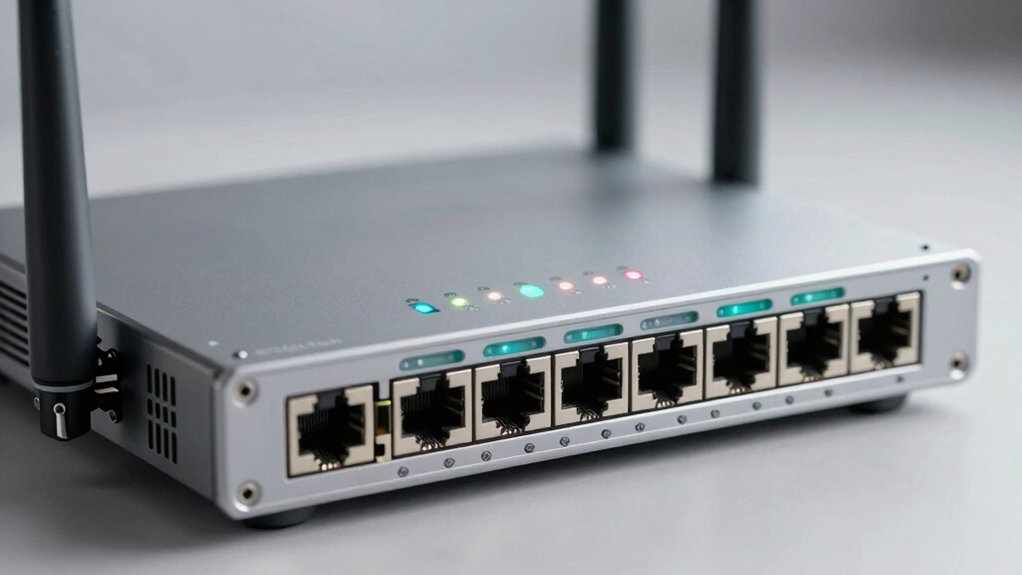
When you select a WiFi router with VLAN support, you’ll need to evaluate its network segmentation capabilities to isolate traffic between departments or user groups, examine the security protocols and encryption standards it offers to protect your data, and assess its processing power to handle your current and future bandwidth demands. Next, you should confirm the router’s scalability features so it can grow with your network without requiring a complete replacement, and review its management interface to ensure you can configure VLANs and monitor performance without excessive technical complexity. These five factors work together to determine whether a router will meet your organization’s needs both today and in the coming years.
Network Segmentation Capabilities
How do you isolate traffic between your IoT devices, guest users, and work computers on a single network? You assign each LAN port and Wi-Fi SSID to a specific VLAN. This separation prevents IoT devices from accessing work files and keeps guests disconnected from sensitive systems. Next, configure traffic flow control policies that determine which VLANs communicate with others. For example, allow your work VLAN to access the internet but block it from reaching IoT devices. You can route VPN services like OpenVPN or WireGuard to specific VLANs, enabling selective VPN access. Preconfigured VLAN options let you segment networks without hardware changes, making it simple to separate high-risk devices from trusted ones instantly.
Security Protocols And Encryption
What’s the foundation of your network’s defense against unauthorized access and data interception? Your router’s security protocols and encryption standards. Choose routers offering WPA3, the strongest current standard, with WPA2 compatibility for older devices needing backward support. Verify your router includes a firewall with SPI (Stateful Packet Inspection), DoS defense, and IP/MAC filtering to block external threats. Enable encrypted DNS using providers like Cloudflare or Quad9 to prevent DNS-based tracking and malicious content loading. Confirm VPN support through OpenVPN, IPsec, or WireGuard for encrypted remote access and site-to-site connections. Check that your firewall allows VPN pass-through without compromising security. These layered protections work together to safeguard your segmented networks and sensitive data from unauthorized access.
Performance And Processing Power
Your router’s CPU, RAM, and hardware acceleration capabilities directly determine whether it’ll handle multiple VLANs smoothly or bog down under load. Choose a router with a multi-core CPU running at 1.2 GHz or higher to manage simultaneous VPN, firewall, and VLAN routing tasks without performance degradation. Select models with at least 256 MB of RAM to support concurrent sessions and QoS scheduling across your network segments. Verify hardware NAT acceleration is enabled to maintain fast throughput for multiple VLAN subnets. Prioritize routers featuring Wi-Fi 6 or 7 with multi-gigabit ports, which reduce bottlenecks when distributing traffic across wired and wireless clients. These specifications ensure your network handles inter-VLAN communication with minimal latency.
Scalability For Growing Networks
As your network expands beyond a handful of devices, you’ll need to plan for VLAN growth from the start. Choose routers offering multiple preconfigured VLANs—typically 10 to 50 or more—rather than devices with rigid limits. Verify the router supports inter-VLAN routing with controlled traffic flow between segments, enabling you to isolate IoT, guest, and work networks as you add devices. For larger deployments, select enterprise or SMB-focused models that include VLAN-based QoS and centralized management through SDN or cloud controllers. These features simplify scaling across multiple access points and switches. Additionally, assess the router’s CPU and memory capacity, since higher VLAN counts increase processing demands. Prioritize hardware capable of handling routing overhead without performance degradation as your network grows.
Management Interface And Control
Once you’ve planned your network’s growth and VLAN structure, you’ll need a management interface that lets you configure and monitor those VLANs with precision. Look for routers offering centralized SDN or controller features—like TP-Link’s Omada or ASUS ExpertWiFi—that simplify management across multiple access points and switches. Your interface should support per-VLAN firewall policies, QoS settings, and VPN routing decisions for traffic isolation. Verify the router handles 802.1Q tagging on both wired and wireless interfaces. Choose a dashboard displaying real-time VLAN usage, device assignments, and cross-VLAN traffic monitoring. A clear, policy-driven design ensures you’ll quickly adjust configurations without navigating confusing menus. This straightforward approach saves time and reduces configuration errors.
Device Capacity And Connectivity
When selecting a VLAN-capable router, you’ll need to evaluate how many devices it can handle across multiple network segments and what connection speeds it supports. Check the router’s CPU and RAM specifications, as these directly impact performance when running multiple VLANs simultaneously. Count your total connected devices—including wired and wireless—to ensure the router won’t bottleneck under load. Look for models with 2.5GbE or multi-Gig ports on both WAN and LAN sides; these reduce inter-VLAN traffic congestion. Verify whether the router supports dual WAN links with VLAN-aware load balancing if you need redundancy across network segments. Finally, confirm the firmware supports the number of assignable VLANs you require and enables complete isolation or routing between them.
VPN Integration And Support
Why should you care about VPN integration when choosing a VLAN-capable router? VPN support lets you route specific VLANs through encrypted connections while others use your regular ISP connection. First, check which protocols the router supports: OpenVPN, IPsec, WireGuard, or L2TP each offer different security levels and use cases. Second, verify if the device can run a VPN client and server simultaneously, allowing devices inside a VLAN to connect to external VPNs while hosting remote access. Third, confirm the router provides per-VLAN policy control so you can direct different networks through intended paths. Finally, review accompanying security features like firewall policies, DoS protection, and VPN pass-through to protect both encrypted and unencrypted traffic across your VLANs.
Compatibility With Existing Infrastructure
Your new router’s VLAN capabilities need to work seamlessly with the network equipment you’ve already got in place. Check if your router supports 802.1Q tagging, which ensures consistent VLAN identification across your switches and existing devices. Verify that VLAN IDs you assign to the router match those configured on your current switch stack. Confirm the number of VLANs your new router can handle aligns with your planned networks—IoT, guest, and work segments. Test inter-VLAN communication to ensure devices on different VLANs can communicate when needed. Review whether your router offers VLAN-aware features like per-VLAN firewall rules and separate DHCP scopes for each segment. Document all VLAN configurations before installation to prevent network disruptions and ensure smooth integration with your existing infrastructure.
Final Thoughts
You’ll want to evaluate your network’s size, device count, and security needs before selecting a router. Compare VLAN capabilities, management options, and encryption standards across models. Prioritize routers offering 802.1Q tagging, centralized controllers, and per-VLAN firewall rules. Test compatibility with your existing infrastructure. Choose hardware supporting your current bandwidth requirements plus future growth, ensuring adequate ports and processing power for your deployment scale.

Meet Ry, “TechGuru,” a 36-year-old technology enthusiast with a deep passion for tech innovations. With extensive experience, he specializes in gaming hardware and software, and has expertise in gadgets, custom PCs, and audio.
Besides writing about tech and reviewing new products, he enjoys traveling, hiking, and photography. Committed to keeping up with the latest industry trends, he aims to guide readers in making informed tech decisions.