
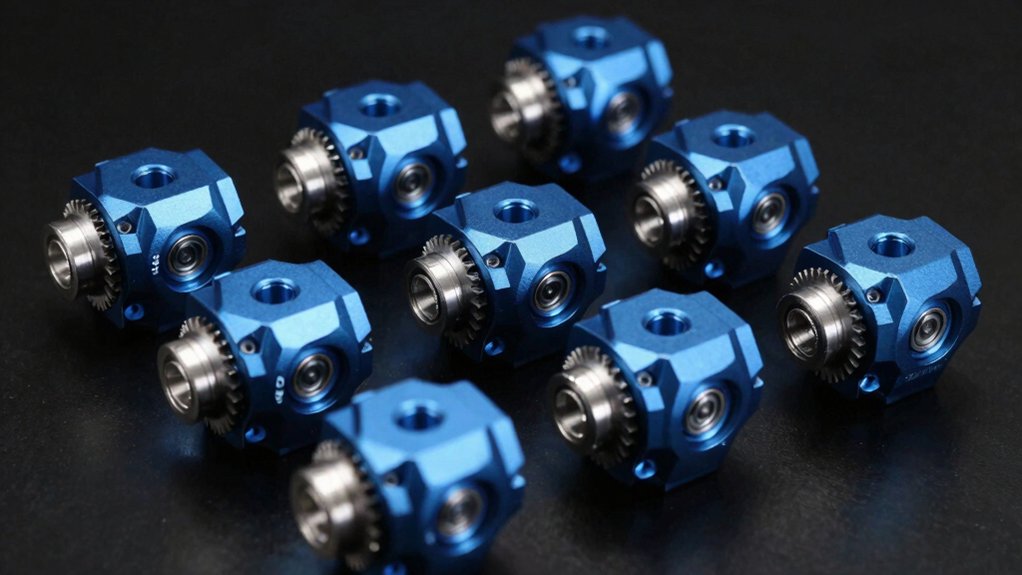

You’ll compare the top harmonic gear drive reducers for a NEMA 17 by checking ratios from 30 to 100:1, verifying zero-backlash and high torque, and confirming direct motor-flange compatibility. Evaluate models with 2–5 Nm running torque, IP40 protection, and clear installation guidance. Consider options with multiple ratio choices (30, 50, 80, 100) and adjustable flanges to simplify alignment. Gather specs, note tolerances, and plan installation steps; you’ll want a practical path to a precise, durable setup that supports your exact motor and workload, then decide what to prototype next.
Harmonic Gear Drive Reducer for NEMA 17 (50:1)
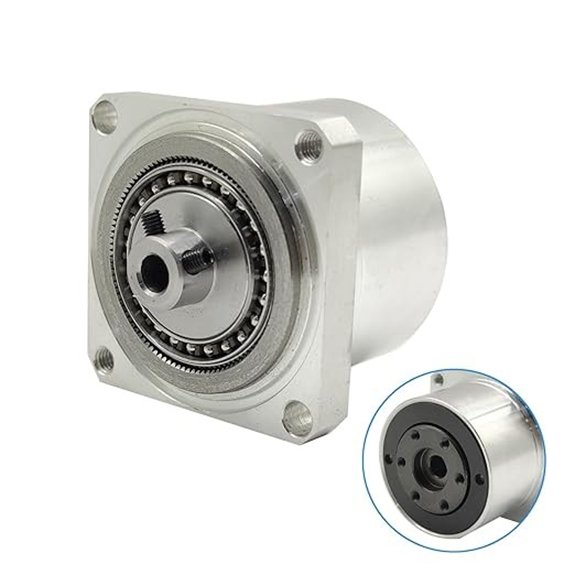
The Harmonic Gear Drive Reducer for NEMA 17 (50:1) is a strong choice when you need a compact, high-torque solution with zero-backlash for a NEMA 17 motor. You fit it by direct mounting to a NEMA 17 stepper, using the customized flange for alignment. Connect the flange, ensure bolts are tight, and verify alignment before operation. Choose a 50:1 or 30:1 option, then confirm the strain-wave gearing provides low backlash and high torque. Check weight and size advantages, and review the description for specifications. Contact support for files or questions, and document your installation steps.
Harmonic Drive Reducer: 100:1 Rotary Output for NEMA17
https://m.media-amazon.com/images/I/61J8tSiX2LL._SX522_.jpg
Consider choosing the Harmonic Gear Drive Reducer with a 100:1 output for a NEMA 17 when you need high torque in a compact package. You select the model that fits a NEMA 17 stepper directly, using the available flange or the customized flange option. You verify the strain wave gearing provides zero-backlash and high precision. You note gear ratios available are 30, 50, 80, and 100, with low backlash and high torque. You plan applications in robots, CNC, or medical instruments. You contact support for specs and files, ensuring correct installation and alignment for your system.
Harmonic Gear Drive Reducer with NEMA 17 Motor
https://m.media-amazon.com/images/I/41+-7w+KbML._SX342_SY445_QL70_FMwebp_.jpg
A Harmonic Gear Drive Reducer with a NEMA 17 motor is a strong choice for lightweight DIY robots and small rotary platforms because it combines compact size with precise motion control. You install the reducer and motor as a unit, connect the 4-wire cable, and power from DC 24V. Set the ratio to 30:1, then verify the 0.06 degree step angle and 2 arcmin backlash. Check protection level IP40 and advised running torque of 1.5 NM. Use the 0.9 x 1.7 x 1.7 inch motor and overall 1.9 x 1.7 x 1.7 inch package for fit. Contact support for questions.
Harmonic Drive Reducer for NEMA 17 Stepper Motor
https://m.media-amazon.com/images/I/61J8tSiX2LL._SX522_.jpg
Choose a Harmonic Drive Reducer for a NEMA 17 stepper by focusing on the 80:1 flange-output option. This unit directly fits NEMA 17 motors and uses strain wave gearing for low backlash and high torque. Check that the flange is customized for easy assembly and aligns with your motor’s bolt pattern. Review key specs: 80:1 reduction, 5 Nm output at 2000 r/min input, peak 11 Nm, and backlashes under 20 arcsec. Confirm permissible speeds, weight, and inertia. Plan installation with the flange output facing the intended axis, ensure secure mounting, and verify zero-backlash benefits in your application.
Harmonic Gear Drive Reducer with Nema 17 Motor
https://m.media-amazon.com/images/I/61gEErO5QGL._SX522_.jpg
This Harmonic Gear Drive Reducer with Nema 17 Motor stands out for DIY robotics and lightweight rotary platforms thanks to its compact motor and precise 30:1 reduction. You install the unit on your project by matching the 24 V DC supply, then attach the 4-wire cable. Check the rated current of 1.4 A and ensure wiring aligns with polarity. Expect 0.06 degree step angle and 2 arcmin backlash, balancing precision with ease of use. Use the 2.1 N·m running torque as a performance target, and note IP40 protection for indoor, non-wet environments. For inquiries, contact the seller.
Harmonic Drive Nema 23 Servo Motor Gear Joint
https://m.media-amazon.com/images/I/61JyWCcFUCL._SX522_.jpg
If you’re selecting a Harmonic Drive Nema 23 gear joint, look for the WXS-series with 30 Aresc backlash and models WXS17-30, WXS17-50, WXS17-80, or WXS17-100 to ensure precise, repeatable motion. This setup offers compact design and space savings, useful for tight robotics joints. Choose a model by reduction ratio: 30, 50, 80, or 100, matching your target torque and speed. Check rated torque at 2000 r/min and allowed peak torque for safety. Confirm flange is 57 mm and input speed range 3500–8500. Verify WXS17-30 through WXS17-100 compatibility with your servo motor and control system. Install, test, and document performance for maintenance.
Factors to Consider When Choosing Harmonic Gear Drive Reducers
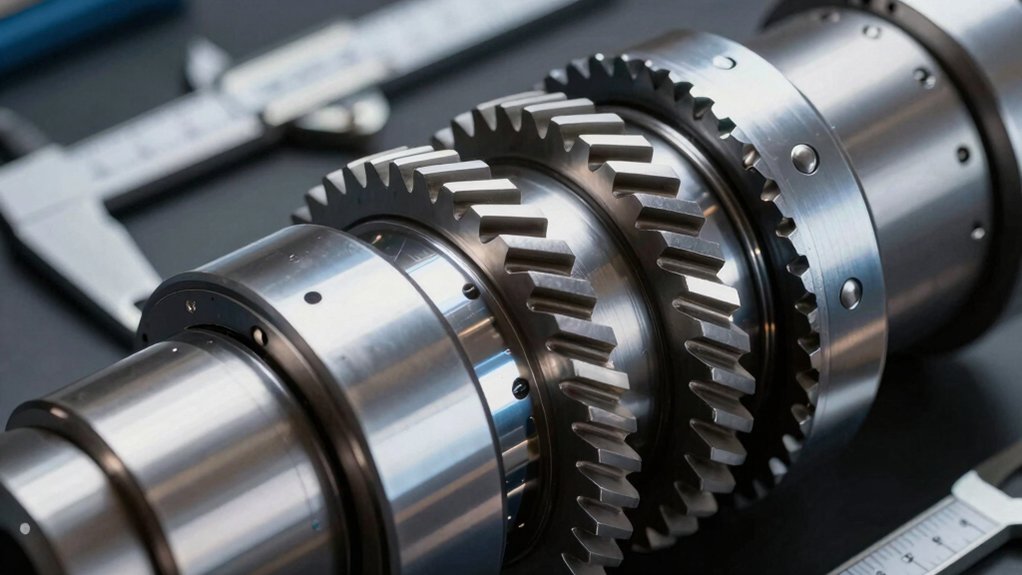
When choosing harmonic gear drive reducers, start by comparing gear ratios to match your speed and torque needs, and note how each option affects overall system efficiency. Next, check backlash levels and torque capacity, ensuring the unit can handle your load with the desired precision and safety margins. Finally, assess motor compatibility, plus size and weight, so you can fit the reducer into your design and confirm mounting and cooling requirements.
Gear Ratios Available
Gear ratios determine how much the output speed is reduced and how much torque is amplified. You’ll see common options like 30:1, 50:1, 80:1, and 100:1, with models offering these selections. Choose 30:1 for lighter loads and faster response, 50:1 for general duties, 80:1 for higher precision and torque, or 100:1 for heavy loads and tight control. Higher ratios increase torque multiplication but may reduce speed and add latency in feedback. Verify the selection set on the product listing and confirm it covers your task range. Many designs list a 30/50/80/100 set to cover broad applications, from light to high-precision. Correlate ratio with backlash, precision, and inertia needs to ensure zero-backlash goals and positional accuracy. Plan your choice based on load, speed, and control requirements.
Backlash Levels
Backlash levels directly affect how precisely your system positions and repeats movements after setting a target. Backlash in harmonic gear drives is typically specified in arcseconds, with values such as < 20 arcsec (80:1) and 2 arcmin (30:1) in different models. Zero-backlash is a common claimed benefit of harmonic reducers due to strain-wave gearing and elastic metal components. When you compare products, note that lower arcsecond figures improve positional accuracy and repeatability, which matters for precision tasks. Some models list explicit backlash values alongside torque and speed specs, signaling backlash as a key differentiator across ratios like 30:1, 50:1, 80:1, and 100:1. Verify each part number; higher reduction does not guarantee the same backlash.
Torque Capacity
Torque capacity defines what the reducer can safely handle without overstressing the gears. You start by checking rated torque at the input speed, such as 8.8 Nm at 2000 r/min for a model like WXS17-30, and note the allowable peak torque at start/stop, for example 16 Nm, to ensure safe operation. Next, assess instantaneous max torque, which may reach 30–143 Nm in some variants; use this only for brief transients, because continuous exceedance harms longevity. Then review maximum average load torque, often 12–51 Nm, to prevent long-term gear strain and backlash rise. Consider design life and material limits, such as backlashes under 20 arcsec and life hours around 7000, to gauge torque headroom. Finally, match reduction ratio with motor capability and input speed to avoid overstress.
Motor Compatibility
When selecting a harmonic gear drive reducer, start by confirming the motor fits the unit’s flange and size, then verify the motor’s electrical needs align with the model’s requirements. Check if the drive is designed for NEMA 17 or NEMA 23 motors and ensure the flange matches your mounting plan. Confirm electrical specs meet the model’s needs, including current around 1.0–1.4 A and voltages near 24 V DC, so wiring and control are compatible. Review the motor’s flange dimensions and overall cross-section to match the output flange and motor size, typically about 0.9–1.7 inches. Consider available gear ratios like 30, 50, 80, and 100:1, and assess how each ratio impacts torque delivery and motor loading.
Size and Weight
Size and weight drive how you fit a harmonic gear drive reducer into your system. You start by checking size. Harmonic reducers are compact, offering 30:1 to 100:1 in a small package. Examine overall length and width with flange outputs to ensure enclosure clearance. Next, assess weight. Typical units range from about 0.4 kg to 0.9 kg, depending on ratio and motor integration, which helps keep your system lightweight. Consider mounting options, such as flange-output designs with NEMA 17 motor mounts, to maintain a short assembly. Evaluate torque against space; higher ratios like 80:1 or 100:1 provide more peak torque in small packages. Finally, factor in backlash, which remains very low and supports precise size-torque alignment in limited spaces.
Mounting Flange
Mounting flanges standardize how the reducer attaches to a motor, so start by checking compatibility with common flange patterns like the NEMA 17. Confirm direct-fit compatibility to avoid adapters. The flange output provides a rigid, axis-aligned interface that transfers torque without coupling shafts, aiding precise alignment and reducing backlash-related issues. If you need customization, consider customized flanges to mate the reducer to specific motors, enabling easier assembly and compact layouts. Check how the flange design affects overall length and footprint, since it influences space savings and installation clearances in robotic or CNC setups. Ensure tight tolerances on mounting holes and bolt patterns to maintain repeatable accuracy and prevent rotational play in high-precision positioning. Document required hole spacing and bolt size for your exact motor model.
Longevity & Life
Longevity and life expectancy depend on how you select and use harmonic gear drive reducers. First, check design life ratings, such as 7000 hours, to set expectations for service duration under your operating conditions. Next, evaluate backlash specs, aiming for lower values (< 20 arcsec to 2 arcmin) to maintain precision and reduce wear-induced errors over time. Then, review permissible max input speeds up to about 8500 r/min; stay within this range to protect gear integrity and extend life. Also consider instantaneous max torque (for example, 91–143 Nm in 80–100:1 variants); avoid overloading that shortens gearbox life. Finally, compare gear ratios (30:1 to 100:1) and micro-geometry; select combinations that distribute load and minimize localized wear.
Price Considerations
When choosing harmonic gear drive reducers, price is driven by precision and versatility, so start by listing your requirements and options. First, note that higher gear ratios, like 30:1 to 100:1, cost more due to precision manufacturing and tighter backlash specs. Next, consider backlash targets, such as under 20 arcsec to 2 arcmin, which raise price because of tighter tolerances and quality materials. Evaluate direct flange-output designs for NEMA 17 motors; these can lower assembly costs but still vary with ratio and torque, influencing total price. Also, larger torque ratings or peak torque up to 70–113 Nm push prices higher due to stronger harmonic components and durability. Finally, check models with multiple ratios (30/50/80/100) for cost efficiency if you reuse a common housing.
Final Thoughts
You’ve reviewed several Harmonic Gear Drive options for NEMA 17 and noted key specs like 30–100:1 ratios, low backlash under 2 arcmin, and 2–5 Nm running torque. Now, decide on your target: choose a model with 50:1 or 80:1 for a balance of speed and torque, ensure IP40 protection, and confirm input speed limits. Verify flange compatibility and installation guidance. Compile a short list of preferred models with tolerances, then request quotes and installation support from the supplier.

Meet Ry, “TechGuru,” a 36-year-old technology enthusiast with a deep passion for tech innovations. With extensive experience, he specializes in gaming hardware and software, and has expertise in gadgets, custom PCs, and audio.
Besides writing about tech and reviewing new products, he enjoys traveling, hiking, and photography. Committed to keeping up with the latest industry trends, he aims to guide readers in making informed tech decisions.