
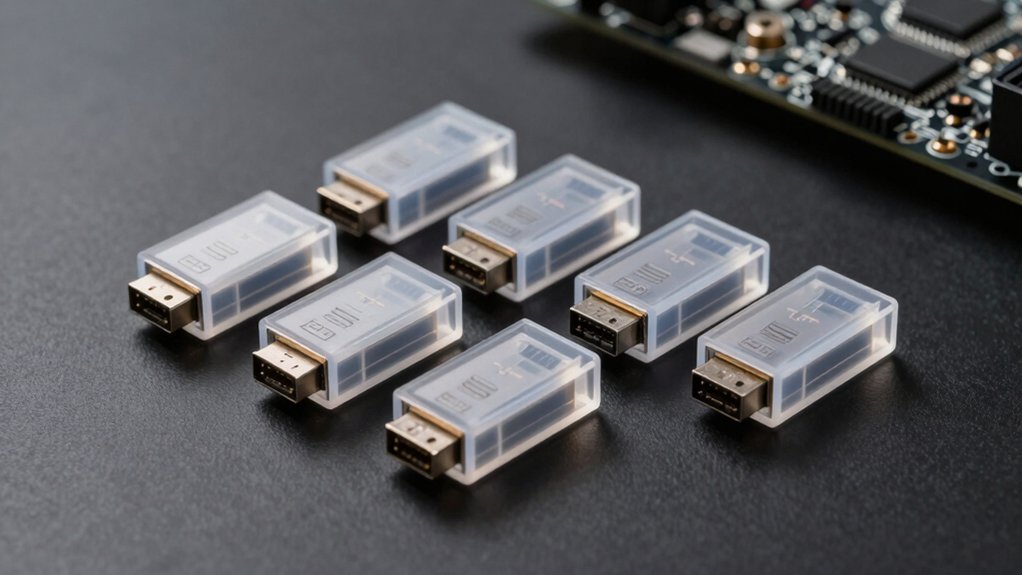

You’re planning a clean, functional build, so start with six solid USB header splitters. Compare OwlTree’s dual 9-pin and a motherboard 9-pin dual extension for direct header compatibility, then consider the NZXT Internal USB Hub for multiple ports. Add a USB 3.0/2.0 splitter to expand speed options, and pair with a USB 2.0 9-pin dual header extension for flexible routing. Each option includes shielded copper wires, mis-insert protection, and compatible layouts—pick the combination that keeps cables neat and power delivery reliable, and you’ll uncover practical gains as you continue.
| OwlTree USB 2.0 Dual 9-Pin Header Splitter |

| Best Shielded | Purpose: USB header splitter for motherboard | Type: 9-pin splitter (dual) | Shielding: Shielded | VIEW LATEST PRICE | Read Our Analysis |
| Motherboard USB 9-Pin Dual Extension Cable |

| Dual-Header Flex | Purpose: USB header splitter extension cable | Type: 9-pin splitter | Shielding: Shielded | VIEW LATEST PRICE | Read Our Analysis |
| NZXT Internal USB Hub 3 — 4 USB 2.0 Ports |

| Internal Hub Hero | Purpose: Internal USB hub expansion | Type: Internal hub | Shielding: Not specified as shielding (hub may use internal connections) | VIEW LATEST PRICE | Read Our Analysis |
| USB 3.0 Header Splitter Cable (1 to 2) |

| USB3.0 Expand | Purpose: USB 3.0 header splitter cable | Type: USB 3.0 header splitter | Shielding: Not specified as shielding | VIEW LATEST PRICE | Read Our Analysis |
| OwlTree USB 2.0 Dual 9-Pin Header Splitter |

| Premium Shielded (OwlTree) | Purpose: USB header splitter (dual 9-pin) | Type: 9-pin splitter (dual) | Shielding: Shielded | VIEW LATEST PRICE | Read Our Analysis |
| USB 2.0 9-Pin Dual Header Extension Cable |

| Compact Dual Splitter | Purpose: USB header extension/splitter cable | Type: 9-pin dual extension splitter | Shielding: Shielded | VIEW LATEST PRICE | Read Our Analysis |
More Details on Our Top Picks
OwlTree USB 2.0 Dual 9-Pin Header Splitter
The OwlTree USB 2.0 Dual 9-Pin Header Splitter is ideal if you need to expand a single motherboard USB 2.0 header into two usable ports without adding clutter. You install the 9-pin header splitter by aligning it with the motherboard header and pressing it straight in until it seats. The package includes two splitters, each 6.3 inches long, for two separate ports. The shielded cable design reduces interference and improves speed, so devices perform more reliably. The mis-insert protection prevents incorrect plug-in, and the blocking hole design helps you avoid mistakes during installation.
- Purpose:USB header splitter for motherboard
- Type:9-pin splitter (dual)
- Shielding:Shielded
- Length / Size:6.3 inches
- Data Rate Capability:USB 2.0 (480 Mbps)
- Mounting / Installation:Internal motherboard usage
- Additional Feature:6.3 inch cable length
- Additional Feature:Dual 9-pin ports
- Additional Feature:Misuse blocking hole
Motherboard USB 9-Pin Dual Extension Cable
If you’re building a new PC and want a clean, simple way to handle USB headers, the Motherboard 9pin USB2.0 to Dual 9pin Extension Cable stands out for straight, plug‑and‑play expansion. This is a 9 pin to 2×9 pin splitter, with a black, shielded, sleeved cable about 16 cm long. It splits a single motherboard header into two, supporting USB 2.0 up to 480 Mbps. The shield reduces EMI, and the black sleeve keeps cables neat. Use one port for power and the other for data, and note some motherboards may not support front-panel USB. Contact the seller for questions.
- Purpose:USB header splitter extension cable
- Type:9-pin splitter
- Shielding:Shielded
- Length / Size:16 cm (~6 inches)
- Data Rate Capability:USB 2.0 (480 Mbps)
- Mounting / Installation:Internal motherboard usage
- Additional Feature:16 cm length
- Additional Feature:Shielded, sleeved cable
- Additional Feature:Data vs power split (one data, one power)
NZXT Internal USB Hub 3 — 4 USB 2.0 Ports
NZXT Internal USB Hub 3 — 4 USB 2.0 Ports is a slim, plug-and-play solution that adds four USB 2.0 ports from a single motherboard connection, ideal when you need more USB access without clutter. You’ll install it to expand internal ports using the motherboard’s USB 2.0 header. The hub uses a SATA power connection for stable power. Place the magnetic hub, attach with the included 3M dual lock, and run the USB cable from the motherboard header to the hub’s port. It supports all compatible PC components and devices needing USB 2.0 connectivity.
- Purpose:Internal USB hub expansion
- Type:Internal hub
- Shielding:Not specified as shielding (hub may use internal connections)
- Length / Size:Not applicable (hub unit size given)
- Data Rate Capability:USB 2.0 (480 Mbps)
- Mounting / Installation:Internal PC build mounting option
- Additional Feature:SATA power connection
- Additional Feature:Magnetic body
- Additional Feature:4 USB 2.0 ports + 1 header
USB 3.0 Header Splitter Cable (1 to 2)
A USB 3.0 header splitter cable (1 to 2) is ideal when you need to connect multiple USB 3.0 devices to a single motherboard header without running separate header cables. This extension cable expands a motherboard USB3.0 IDC 19/20 pin header to two headers, enabling more devices to connect. It supports up to 5 Gbps and remains backward compatible with USB 2.0 at 480 Mbps. Use the flat black ribbon cable for durability and flexible placement. If a connection loosens, gently swing left and right while pulling. Contact support for issues and review compatibility notes before installation.
- Purpose:USB 3.0 header splitter cable
- Type:USB 3.0 header splitter
- Shielding:Not specified as shielding
- Length / Size:Not specified (cable length implied internal)
- Data Rate Capability:USB 3.0 (up to 5 Gbps) with USB 2.0 backward
- Mounting / Installation:Internal motherboard usage
- Additional Feature:USB3.0 up to 5 Gbps
- Additional Feature:Backward compatible USB2.0
- Additional Feature:Flat ribbon cable
OwlTree USB 2.0 Dual 9-Pin Header Splitter
The OwlTree USB 2.0 Dual 9-Pin Header Splitter is a practical choice when you need to expand a single motherboard USB 2.0 header into two usable ports. You receive two 6.3 inch splitters in braided white, each converting one USB2.0 9-pin header into dual 9-pin ports. Install by locating the motherboard header, align, and plug in both splitters. The shielded cable design reduces interference and speeds up transmission. Materials include 24AWG tinned copper wire and premium shielding. The integrative injection-mold body offers higher quality than standard splitters. Each package includes two splitters for immediate use.
- Purpose:USB header splitter (dual 9-pin)
- Type:9-pin splitter (dual)
- Shielding:Shielded
- Length / Size:6.3 inches
- Data Rate Capability:USB 2.0 (480 Mbps)
- Mounting / Installation:Internal motherboard usage
- Additional Feature:Braided nylon weave
- Additional Feature:Integrative injection mold
- Additional Feature:6.3 inch length
USB 2.0 9-Pin Dual Header Extension Cable
Look for its dual 9-pin USB 2.0 header design when you’re choosing a splitter, as this cable lets you extend two USB 2.0 headers from a single motherboard port. You connect one port for power and the other for data transfer, so plan placement inside the case. The cable is 16 cm long, black, with copper wire and a shielded design to minimize interference. It supports USB 2.0 speeds up to 480 Mbps and works for keyboards, mice, and external storage without performance loss. Front USB compatibility may vary by motherboard, so verify before use.
- Purpose:USB header extension/splitter cable
- Type:9-pin dual extension splitter
- Shielding:Shielded
- Length / Size:16 cm (~6 inches)
- Data Rate Capability:USB 2.0 (480 Mbps)
- Mounting / Installation:Internal motherboard usage
- Additional Feature:16 cm length
- Additional Feature:Copper wire with black sleeve
- Additional Feature:One port powers, one data
Factors to Consider When Choosing USB Header Splitter

When choosing a USB header splitter, assess shielding and EMI reduction to prevent interference, and verify whether the design supports both data and power splitting for your needs. Consider cable length and routing options, ensuring the length fits your case layout and won’t cause signal loss or clutter. Confirm board compatibility and build quality by checking materials and construction, then compare options for durability and ease of installation.
Shielding and EMI Reduction
Shielding helps keep USB signals clean in noisy cases. When you choose a USB header splitter, look for materials like 24AWG tinned copper wire and aluminum foil to reduce EMI and protect signal integrity. A shielded design helps maintain higher transmission speeds and more stable connections for USB 2.0 signals, up to 480 Mbps. Braided shielding and insulated sleeves minimize cross-talk between adjacent wires in dual-header extensions, so verify these features are included. Shielded cables are paired with practical protections, such as mis-insert prevention, to preserve data transmission when shielding is present. Consider how EMI reduction improves overall performance in a noisy PC chassis and with multiple USB devices, and prioritize a design that combines shielding with reliable connectors.
Data Vs Power Split
In most USB header splitters, one header carries data while the other provides power, so you typically can’t run data on both ports at once. Start by identifying which header handles data by checking the product notes or manual. If data is on Header A and power on Header B, plan your devices accordingly. Understand the data rate: USB 2.0 splitters commonly support up to 480 Mbps total data rate, with power shared or divided between headers. Ensure your periphery matches this limit, especially for faster devices. Some splitters specify only one header powers a device at a time, so avoid high-power peripherals on both ports. Front-panel or motherboard design can alter data versus power roles, so verify before purchase.
Cable Length Considerations
Choosing the right USB header splitter length depends on your motherboard layout and case design. You start by measuring the distance from the header to the nearest drive bay or cable channel. Pick a length that fits without bending the connectors. Common options are around 6 inches (15 cm) to 16 cm, with 16 cm offering a compact fit for tidy builds. If you need more slack, choose a longer option, but note longer cables can add clutter and slight signal delay. Ensure the length matches the header position to avoid tension or misalignment at the connectors. Excessively long cables increase EMI exposure and require extra management for airflow. If multiple devices connect, select a length that minimizes sharp bends and preserves signal integrity.
Compatibility With Boards
How should you approach compatibility when selecting a USB header splitter for your board? Start by matching the motherboard’s 9-pin USB 2.0 header layout to the splitter’s pin configuration, ensuring correct data and power mapping. Check that the splitter’s connectors align with your board’s header and case ports. Note that some splitters power one port while the other handles data, so front-panel compatibility can vary and may affect usable ports. Remember that the two expansion ports typically cannot transmit data simultaneously, which influences which header you attach to a given device. Front USB compatibility with certain motherboard models may be inconsistent, requiring vendor support or alternative solutions. Consider shielded or braided cables to improve EMI performance on compatible boards.
Build Quality Materials
When you choose a USB header splitter, evaluate build quality materials first to ensure long-term reliability. Start with shielding: choose cables with premium shielding, like aluminum foil and braided copper with nylon, to reduce interference and stabilize USB data transmission. Next, inspect conductor wires: 24 AWG tinned copper wires improve conduction and durability in splitter cables. Verify construction: integrative injection mold housing typically yields a sturdier splitter than basic designs, offering better long-term performance. Look for mis-insert protection: a mistake-proof design helps prevent incorrect USB header connections. Assess overall integration: ensure shielding, conductors, and housing work together without gaps or loose parts. Finally, confirm compatibility with your motherboard layout and case space to maintain clean cable management.
Final Thoughts
To choose the right USB header splitter, compare your needs and follow these steps: identify your motherboard header type (9-pin or 20-pin, USB 2.0/3.0), check data and power requirements, and examine shielded cables for EMI reduction. Pick a model that matches your header layout and offers mis-insert protection. Consider OwlTree or NZXT options for 2–4 ports. Verify compatibility, then install, route cables neatly, and test each port for stable data transfer.

Meet Ry, “TechGuru,” a 36-year-old technology enthusiast with a deep passion for tech innovations. With extensive experience, he specializes in gaming hardware and software, and has expertise in gadgets, custom PCs, and audio.
Besides writing about tech and reviewing new products, he enjoys traveling, hiking, and photography. Committed to keeping up with the latest industry trends, he aims to guide readers in making informed tech decisions.