
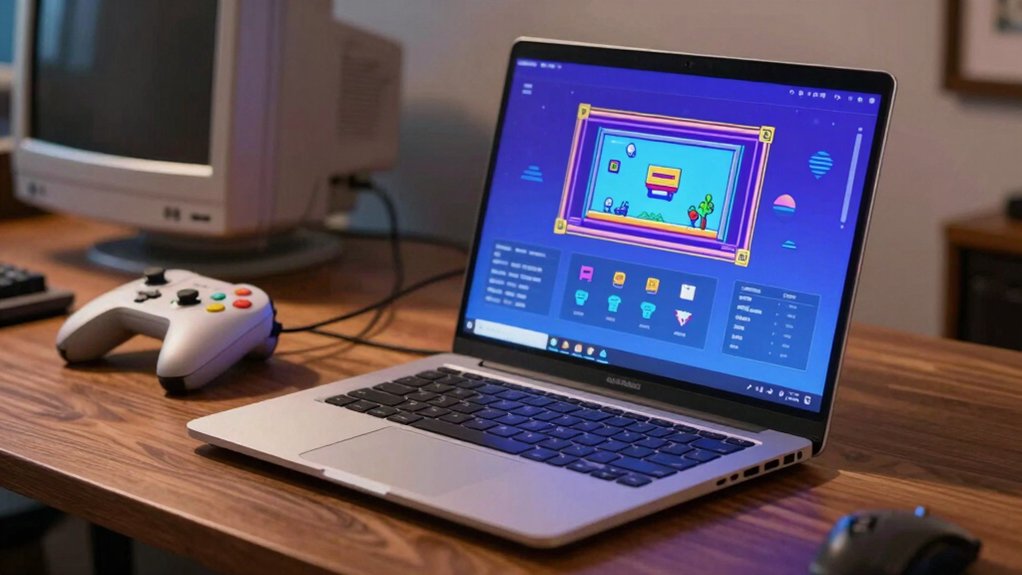

Consider these five emulation-ready options. Choose the NIMO 15.6″ Ryzen 7 Pro with 32GB RAM, 1TB SSD, and Radeon 680M for heavy loads and stability on Windows 11 Pro; it handles multiple emulators and uses a 100W PD charger. If you want balanced power and portability, pick the 15.6″ Gaming Laptop with 16GB/512GB and UHD 615 GPU. For budget tests, use Coolby 15.6″ (12GB/256GB) or the 8GB Gold model; renew a basic HP if needed. Each option includes ports to connect controllers and displays; expand storage as required. More details follow to optimize your setup.
| NIMO 15.6″ Ryzen 7 PRO Laptop 32GB 1TB SSD |

| Best Overall | Screen size: 15.6″ | Display type: Full HD anti-glare | Operating system: Windows 11 Pro/Home | VIEW LATEST PRICE | Read Our Analysis |
| 15.6″ Gaming Laptop 16GB RAM 512GB SSD Win 11 Pro |

| Gaming-Capable Generalist | Screen size: 15.6″ | Display type: FHD 1920×1080 | Operating system: Windows 11 Pro | VIEW LATEST PRICE | Read Our Analysis |
| Coolby 15.6″ Laptop 12GB RAM 256GB SSD with Fingerprint |

| Light-Weight Productivity | Screen size: 15.6″ | Display type: FHD 1920×1080 IPS | Operating system: Windows 11 Pro | VIEW LATEST PRICE | Read Our Analysis |
| 15.6″ Laptop with 8GB RAM 256GB SSD Gold |

| Budget-to-Productivity | Screen size: 15.6″ | Display type: FHD IPS | Operating system: (Not explicitly stated; implied Windows) | VIEW LATEST PRICE | Read Our Analysis |
| HP 15.6″ Laptop i NPentium 4GB RAM 128GB Windows 11 (Renewed) |

| Renewed Everyday Workhorse | Screen size: 15.6″ | Display type: 1366 x 768 (HD) | Operating system: Windows 11 (Renewed) | VIEW LATEST PRICE | Read Our Analysis |
More Details on Our Top Picks
NIMO 15.6″ Ryzen 7 PRO Laptop 32GB 1TB SSD
The NIMO 15.6″ Ryzen 7 PRO Laptop, with 32GB of RAM and a 1TB SSD, is a strong pick for emulator-heavy use where speed and reliability matter most. You verify core specs: Ryzen 7 PRO 6850U, 32GB RAM, 1TB PCIe 4.0 SSD, Radeon 680M. You enable Windows 11 Pro, install emulation software, and ensure updates finish. You test performance with multiple emulators, adjust power settings, and use the 100W PD charger for stability. You expand storage if needed, connect via USB-C, HDMI, or USB-A, and document results for easy reference. You rely on solid build and USA support.
- Screen size:15.6″
- Display type:Full HD anti-glare
- Operating system:Windows 11 Pro/Home
- RAM amount:32GB
- Storage capacity:1TB SSD
- Form factor type:Traditional clamshell laptop
- Additional Feature:USA-based final assembly
- Additional Feature:2-year manufacturer warranty
- Additional Feature:53.58Wh smart battery
15.6″ Gaming Laptop 16GB RAM 512GB SSD Win 11 Pro
This 15.6″ gaming laptop with 16GB RAM and a 512GB SSD on Windows 11 Pro is best suited for users who want solid emulation performance without sacrificing portability. You examine core specs: 15.6″ display, up to 3.40 GHz, UHD 615, 16GB RAM, 512GB SSD, Win 11 Pro. Use it for emulators by enabling Windows features, updating drivers, and keeping SSD healthy. Check connectivity: WiFi, Bluetooth, USB-A ports, HDMI, Type-C. Ensure battery life meets needs, and leverage 38Wh capacity for multitasking. For gaming, test games, adjust settings, and monitor temps to stay within power/thermals.
- Screen size:15.6″
- Display type:FHD 1920×1080
- Operating system:Windows 11 Pro
- RAM amount:16GB
- Storage capacity:512GB SSD
- Form factor type:Traditional clamshell laptop
- Additional Feature:5G WiFi support
- Additional Feature:30W front camera
- Additional Feature:Privacy anti-peep slider
Coolby 15.6″ Laptop 12GB RAM 256GB SSD with Fingerprint
If you need a budget-friendly option that can handle classic game emulation with minimal fuss, consider the Coolby 15.6″ Laptop with 12GB RAM and 256GB SSD plus fingerprint. This model uses an Intel N95 (Beats N5095) quad-core processor and 12GB RAM, plus a 256GB SSD that’s expandable via MicroTF. It runs Windows 11 Pro preinstalled, includes a fingerprint reader, and offers a 15.6″ FHD IPS display for clear images. Use the two Type-C ports for charging and data, connect to a display via HDMI, and enable WiFi 5 for downloads. Plan storage upgrades if you need more space for games.
- Screen size:15.6″
- Display type:FHD 1920×1080 IPS
- Operating system:Windows 11 Pro
- RAM amount:12GB
- Storage capacity:256GB SSD
- Form factor type:Traditional clamshell laptop
- Additional Feature:4K display capable
- Additional Feature:Dual Type-C charging
- Additional Feature:Privacy shutter 2.0 MP
15.6″ Laptop with 8GB RAM 256GB SSD Gold
For those seeking a compact, budget-friendly option that still handles classic emulation smoothly, this 6″ laptop with 8GB RAM and 256GB SSD in Gold targets casual emulator use without overkill. You will use the Pentium Gold 6500Y to handle light tasks and emulation basics. Open the 15.6″ facts adapted for the 6″ model’s specs; note the 8GB RAM is sufficient for many emulators. Manage storage by using the 256GB SSD and consider expansion up to 512GB via TF card if needed. Connect peripherals via USB-C, USB 3.2, and HDMI for display. Ensure 30‑day support and 1‑year protection.
- Screen size:15.6″
- Display type:FHD IPS
- Operating system:(Not explicitly stated; implied Windows)
- RAM amount:8GB
- Storage capacity:256GB SSD
- Form factor type:Traditional clamshell laptop
- Additional Feature:100% sRGB gamut
- Additional Feature:Expandable to 32GB
- Additional Feature:TF/microSD and NVMe options
HP 15.6″ Laptop i NPentium 4GB RAM 128GB Windows 11 (Renewed)
The HP 15.6″ Laptop (Renewed) is a practical entry point for emulator fans who want a budget option with Windows 11 and a clean, uninterrupted setup. You’ll use the 15.6″ screen for a comfortable view, and you’ll rely on the Intel Pentium quad-core to handle basic emulation. With 4GB RAM, run light games first and monitor performance. Install Windows 11 updates, then add emulation software carefully. Store essential files on the 128GB SSD, and manage space by removing unused apps. Connect to Wi‑Fi 802.11ac, use USB 2.0 for peripherals, and adjust settings for smooth multitasking. Consider upgrading RAM if needed.
- Screen size:15.6″
- Display type:1366 x 768 (HD)
- Operating system:Windows 11 (Renewed)
- RAM amount:4GB
- Storage capacity:128GB SSD
- Form factor type:Traditional clamshell laptop
- Additional Feature:Renewed condition
- Additional Feature:1366×768 display
- Additional Feature:4-core Pentium performance
Factors to Consider When Choosing Laptops for Emulators
Start by evaluating CPU power for emulation, choosing a processor with enough cores and clock speed to handle retro titles smoothly. Next, review GPU and VRAM needs, ensuring the graphics unit can render at the native resolution you want and support any required shaders or plugins. Finally, verify memory, storage, thermals, and port options, selecting ample RAM, fast storage, an effective cooling solution, and a variety of connections for peripherals.
CPU Power for Emulators
Want reliable emulator performance? Start with core count and threads. Choose CPUs with 6–8 cores and 12–16 threads to speed up virtualization and emulation workloads. Check turbo frequency; aim for strong single-core boosts, ideally 4.5 GHz or higher, to reduce lag in timing-sensitive tasks. Evaluate FPU and SIMD features like AVX2 or AVX-512, since math-heavy emulation benefits from parallelized calculations. Ensure adequate L3 cache for fast state transitions and to minimize stutter during rapid instruction sequences. Consider power efficiency, choosing modern microarchitectures that sustain performance per watt. For laptops, balance CPU cores, boost frequency, cache, and efficiency to maintain longer sessions. Verify vendor specifications and compare multi-core benchmarks relevant to your emulation needs.
GPU and VRAM Demands
Focus on GPU and VRAM capacity to guarantee smooth emulation across multiple systems. Start by assessing your emulator’s needs for texture quality and number of concurrent systems. If you plan several simultaneous instances or high-fidelity textures, choose a discrete GPU with ample VRAM, 4–8 GB or more. If you run basic emulation, integrated GPUs like Radeon 680M can suffice, but expect bottlenecks with multiple renders or complex skins. VRAM usage scales with system count, texture quality, and features like anti-aliasing or high-resolution skins, so plan for the highest expected load. For reliability, match GPU VRAM and memory bandwidth to the emulator’s recommended settings rather than maxing out. Prioritize configurations that maintain stable frame rates at your target resolutions and offscreen rendering needs.
Memory and Storage Capacity
Memory matters most for smooth emulation, so prioritize overall system RAM before other upgrades. Start with 16GB as a baseline for multi-app or multi-VM workloads, and target 32GB or higher if you plan heavier Android or console emulation. This reduces swapping and keeps frame rates steadier. Next, evaluate storage speed. Choose an NVMe PCIe SSD for faster app loading and data access; it beats SATA SSDs and eMMC for startup and swap times. Then consider capacity. A 512GB or 1TB drive provides space for ROM sets, BIOS files, and multiple OS images. If budget is tight, prioritize RAM first for smoother emulation, then upgrade storage later. Balance memory capacity with fast storage to maximize responsiveness and future-proofing.
Thermal Management Efficiency
Good cooling is how you keep emulators steady, so start by evaluating how a laptop handles heat under load. Look for advanced cooling features: multiple heat pipes, larger fans, and open airflow paths. These design choices help sustain higher clock speeds and reduce thermal throttling during long CPU/GPU sessions. Consider a lower TDP and balanced power delivery, which keep temperatures stable and support consistent emulation accuracy. Check thermal margins, the gap between hotspot and ambient, because wider margins allow longer run times before throttling. Examine chassis ventilation and heat-dissipation materials, as they affect peak performance and frame pacing. Finally, verify real-world stress tests or manufacturer thermal benchmarks to confirm sustained performance under extended emulator use.
Compatibility and Ports Access
So, start by checking the laptop’s I/O setup to support emulation needs. Ensure you have several USB ports, including USB-A and at least one USB-C with data transfer and Power Delivery. This lets you connect game controllers, external drives, and emulation peripherals without frequent hubs. Look for an HDMI or DisplayPort output to mirror or extend displays for smoother multi-monitor setups and faster video output. Check wireless stability, aiming for Wi‑Fi 5/6 and Bluetooth 5.x to support online features and peripheral pairing without lag. Verify the USB-C port can both charge and data-transfer so you can dock and power the system while emulating. Favor devices with 2–4 total USB ports to avoid swapping hubs.
Final Thoughts
To pick an emulator-ready laptop, start with RAM and CPU first: prioritize 16GB+ for smooth retro gaming, or 32GB for heavy multi-boot setups. Check a capable Ryzen or Core i5/i7 CPU and a fast SSD (512GB+). Ensure proper cooling and a reliable display. Compare models: NIMO for power, a budget 15.6″ option with 8–16GB, and newer Pro/Win 11 machines. Verify ports, battery life, and renewal status if buying used. Choose based on your preferred games and portability.

Meet Ry, “TechGuru,” a 36-year-old technology enthusiast with a deep passion for tech innovations. With extensive experience, he specializes in gaming hardware and software, and has expertise in gadgets, custom PCs, and audio.
Besides writing about tech and reviewing new products, he enjoys traveling, hiking, and photography. Committed to keeping up with the latest industry trends, he aims to guide readers in making informed tech decisions.