
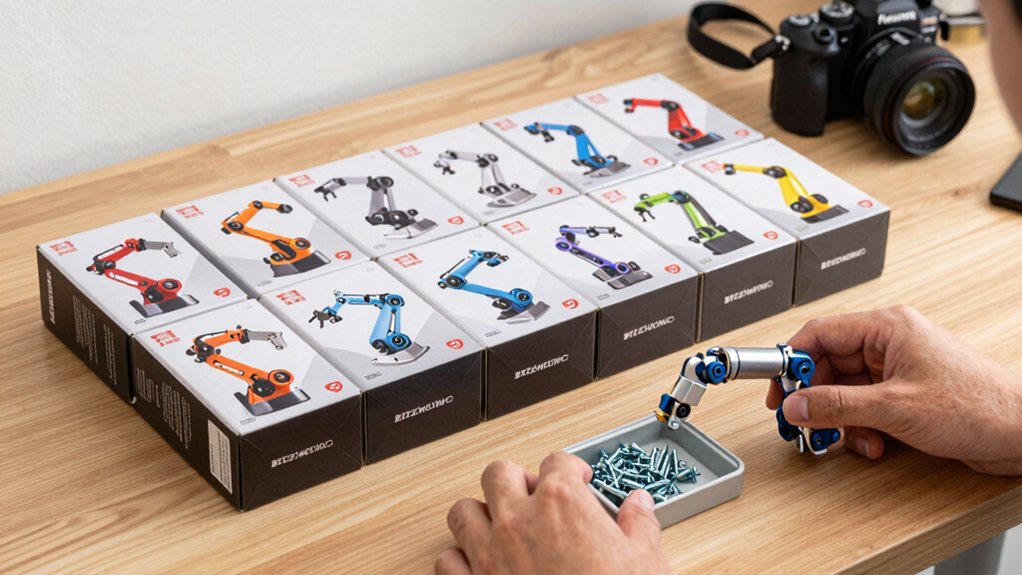

Robotic arm kits have become one of the most exciting ways to explore robotics, automation, and hands-on engineering at home or in the classroom.
Whether you’re a beginner learning the basics of motors and sensors, a student diving into STEM projects, or an advanced maker building programmable automation systems, the right robotic arm kit can dramatically accelerate learning and creativity.
In this guide, we explore the best robotic arm kits available today, highlighting options that balance functionality, expandability, and real-world robotics experience.
| Mechanical Robotic Arm Building Blocks Set (784Pcs) |

| Best Overall | Age Range: 8-14 (8-12 noted by manufacturer) | Key Functionality (Robotic Arm): Remote-controlled articulated arm with claw | Power Source: Battery box with 4 M motors (likely Li-ion internal) | VIEW LATEST PRICE | Read Our Analysis |
| SMIESSKIDDO 3-in-1 Hydraulic Robot Arm Kit |

| Solid Starter Kit | Age Range: 8-12 | Key Functionality (Robotic Arm): 3-in-1 hydraulic arm with 4-jaw grab, suction, tongs | Power Source: No batteries needed | VIEW LATEST PRICE | Read Our Analysis |
| Robotic Arm Kit for STEM Learning (8-12) |

| Beginner-Friendly Build | Age Range: 8-12 | Key Functionality (Robotic Arm): 4DOF robotic arm with grabbing and programming | Power Source: Batteries included (BatteryUS/USB charging) | VIEW LATEST PRICE | Read Our Analysis |
| AI Robotic Arm Kit with Servo and ROS Education |

| AI Education Leader | Age Range: 10-20 | Key Functionality (Robotic Arm): 7-axis humanoid arm with ROS/AI features | Power Source: No explicit batteries listed (robotics platform) | VIEW LATEST PRICE | Read Our Analysis |
| Hydrobot Arm Kit: Hydraulic STEM Building Toy for Kids |

| Hydraulic Powerhouse | Age Range: 12+ | Key Functionality (Robotic Arm): Hydraulics-powered arm with 6 axes | Power Source: No batteries required (hydraulics, water-based) | VIEW LATEST PRICE | Read Our Analysis |
| Bionic Robotic Arm STEM Kit for Ages 10 |

| No-Battery Robotics | Age Range: 10+ | Key Functionality (Robotic Arm): Cable-driven bionic arm (no motors required) | Power Source: No batteries or motors required | VIEW LATEST PRICE | Read Our Analysis |
| 360° Robotic Arm Kit for STEM Kids and Teens |

| 360° Expansion | Age Range: 12-14 | Key Functionality (Robotic Arm): 360° rotating robotic arm with gripper | Power Source: No batteries specified (manual/wooden kit with motors) | VIEW LATEST PRICE | Read Our Analysis |
| Robot Arm Kits for STEM Learning and DIY Projects |

| DIY Electronics Fun | Age Range: 8-16+ | Key Functionality (Robotic Arm): Build-your-own robot arm with motors and PCB | Power Source: Requires 6 AA batteries (not included) | VIEW LATEST PRICE | Read Our Analysis |
| Robot Arm for Arduino: Memory and Repeat Movements Kit |

| Arduino Starter Arm | Age Range: 13+ | Key Functionality (Robotic Arm): 4DF arm with memory of movements | Power Source: Batteries required (nonstandard) | VIEW LATEST PRICE | Read Our Analysis |
| Arduino 5DOF Robotic Arm STEM Starter Kit |

| Open-Source Potential | Age Range: 17+ | Key Functionality (Robotic Arm): 5DOF Arduino-controlled arm with sensors | Power Source: Batteries required (2 Li-ion) | VIEW LATEST PRICE | Read Our Analysis |
More Details on Our Top Picks
Mechanical Robotic Arm Building Blocks Set (784Pcs)
This Mechanical Robotic Arm Building Blocks Set (784Pcs) stands out for beginners and mid-range builders who want a robust, remote-controlled arm with real-world motion. You follow the setup steps methodically: assemble the 784 pieces, connect the four M motors, install the Li-ion battery box, and pair the remote control. Use the 360-degree chassis rotation and two-section bends to position the hand claws, which open and close at 270 degrees. Run tests with the remote, observe grip up to 150 grams, and simulate hydraulic mobility. Consider education value, then assess durability, warranty, and price match options for ongoing projects.
- Age Range:8-14 (8-12 noted by manufacturer)
- Key Functionality (Robotic Arm):Remote-controlled articulated arm with claw
- Power Source:Battery box with 4 M motors (likely Li-ion internal)
- Learning Focus:STEM education, hands-on robotics
- Hands-On Assembly:Yes (building blocks and remote control)
- Learning Outcome / Skill Benefit:Improves hand-eye coordination and engineering skills
- Additional Feature:360-degree chassis rotation
- Additional Feature:8-Way remote control
- Additional Feature:Final grip up to 150g
SMIESSKIDDO 3-in-1 Hydraulic Robot Arm Kit
If you’re evaluating kits for developing hands-on engineering skills, the SMIESSKIDDO 3-in-1 Hydraulic Robot Arm Kit stands out for younger learners who want to understand hydraulic power without batteries. You assemble it in 3–5 hours, using 220 pieces and the 4-jaw grab, suction cup, and tongs. The kit teaches physics and mechanics through hydraulic action, with an ambidextrous, safe design and non-toxic materials. No batteries are required, making it straightforward for classroom or home use. It’s suitable for ages 8–12, promotes problem-solving, and yields “Whoa, I built that!” moments as you complete each configuration.
- Age Range:8-12
- Key Functionality (Robotic Arm):3-in-1 hydraulic arm with 4-jaw grab, suction, tongs
- Power Source:No batteries needed
- Learning Focus:Hydraulic power, problem solving, STEM
- Hands-On Assembly:Yes (assembly time 3-5 hours)
- Learning Outcome / Skill Benefit:Teaches physics/mechanics; engineering problem solving
- Additional Feature:3-in-1 hydraulic functionality
- Additional Feature:No batteries needed
- Additional Feature:Ambidextrous safe design
Robotic Arm Kit for STEM Learning (8-12)
Choose the Robotic Arm Kit for STEM Learning (8-12) when you want a clear, beginner-friendly entry point that combines hands-on building with practical programming. You learn with VANLINNY’s 4DOF Robot Arm, designed for ages 8 and up. The kit moves at multiple angles, rises and falls, and grabs objects, while you program sequences and test outcomes. It includes simulation sound effects, a battery, USB charging cable, DIY tools, and a remote control for 30–50 meter range. Materials are ABS and aluminum alloy, safe for kids, with an 18-month warranty. Follow the packaging, assemble, charge, and start simple tasks.
- Age Range:8-12
- Key Functionality (Robotic Arm):4DOF robotic arm with grabbing and programming
- Power Source:Batteries included (BatteryUS/USB charging)
- Learning Focus:Robotics, programming, engineering
- Hands-On Assembly:Yes (interactive assembly)
- Learning Outcome / Skill Benefit:Robotics programming and control concepts
- Additional Feature:18-month warranty
- Additional Feature:Battery included
- Additional Feature:Long-distance remote control
AI Robotic Arm Kit with Servo and ROS Education
AI Robotic Arm Kit with Servo and ROS Education stands out for its integrated ROS support and 7-axis humanoid arm, making it ideal for learners and developers who want hands-on experience with real-time coordination. You will assess compatibility with ROS1/ROS2, install the Python SDK, and run basic open-source demos. Next, connect the 3D depth camera and enable object tracking, then test grasping tasks using the Movelt workflows. For advanced use, pair with Hugging Face or LeRobot models, run imitation learning or RL experiments, and utilize SparkMind for planning and collision checks. Finally, review dimensions and warranty on the product page.
- Age Range:10-20
- Key Functionality (Robotic Arm):7-axis humanoid arm with ROS/AI features
- Power Source:No explicit batteries listed (robotics platform)
- Learning Focus:AI/ROS education, deep learning, vision
- Hands-On Assembly:Yes (assembly/calibration guides; open development)
- Learning Outcome / Skill Benefit:Reinforcement learning, motion planning, AI perception
- Additional Feature:7-axis humanoid arm
- Additional Feature:Nvidia-compatible AI education
- Additional Feature:Integrated Python SDK
Hydrobot Arm Kit: Hydraulic STEM Building Toy for Kids
Hydrobot Arm Kit stands out for its hydraulics-powered six-axis arm, which delivers controllable motion without batteries. You build a working robot using water hydraulics and lever controls, then test movement across 270-degree rotation. Start by assembling the arm, then connect the gripper or optional suction components to pick up objects. Practice controlling each axis with precise, measured inputs, adjusting fluid pressure as needed. Use the hydraulic system to perform tasks that mirror real engineering challenges, such as gripping small parts or moving objects between locations. This kit emphasizes hands-on learning and cognitive development along with problem solving.
- Age Range:12+
- Key Functionality (Robotic Arm):Hydraulics-powered arm with 6 axes
- Power Source:No batteries required (hydraulics, water-based)
- Learning Focus:Hydraulics, mechanical engineering
- Hands-On Assembly:Yes (construct hydraulic arm)
- Learning Outcome / Skill Benefit:Hydraulics, lever control understanding
- Additional Feature:Water hydraulics power
- Additional Feature:6-axis arm
- Additional Feature:Suction component option
Bionic Robotic Arm STEM Kit for Ages 10
The Thames & Kosmos Bionic Robotic Arm STEM Kit is a strong choice for ages 10+ who want a cable-driven, motor-free build that mirrors real robotic arms. You assemble nearly 300 plastic pieces into a functional segmented arm, threading a network of nylon cables like tendons. Use the joysticks to open, close, and rotate the claw (180 degrees) and practice grabbing objects. No batteries or motors are required, ensuring a clean, mechanical workflow. Learn alongside the full-color manual, which covers biomimicry, mechanical engineering, and real-world arm operation, with a bonus eel-head model option.
- Age Range:10+
- Key Functionality (Robotic Arm):Cable-driven bionic arm (no motors required)
- Power Source:No batteries or motors required
- Learning Focus:Biomimicry, cable-driven robotics, engineering basics
- Hands-On Assembly:Yes (assemble plastic cable-driven system)
- Learning Outcome / Skill Benefit:Understanding cables, tendons, and mechanical actuation
- Additional Feature:Cable-driven system
- Additional Feature:300-piece build
- Additional Feature:Joystick-controlled claws
360° Robotic Arm Kit for STEM Kids and Teens
This 360° Robotic Arm Kit is the best choice for STEM beginners and teens who want hands-on practice with multi-directional movement. You set up the kit by organizing wooden panels, motors, screws, and components. Assemble the frame, connect electronics, and test 360° rotation to verify smooth movement. Use up, down, and turning motions to control the gripper, then practice grabbing and releasing objects with the included gripper. Engage in time-based challenges and educational games to reinforce concepts. It suits parent-child projects and school robotics tasks, keeping projects practical, durable, and easy to integrate into lessons.
- Age Range:12-14
- Key Functionality (Robotic Arm):360° rotating robotic arm with gripper
- Power Source:No batteries specified (manual/wooden kit with motors)
- Learning Focus:DIY STEM learning, robotics projects
- Hands-On Assembly:Yes (assembly of wooden kit with motors)
- Learning Outcome / Skill Benefit:Fine motor skills, problem solving
- Additional Feature:Wooden construction
- Additional Feature:360° rotation
- Additional Feature:Educational games
Robot Arm Kits for STEM Learning and DIY Projects
For those seeking an approachable entry into robotics, look for kits that come with all-in-one components and clear, kid-friendly assembly guides. You explore Robot Arm Kits for STEM learning and DIY projects that include motors, PCB boards, wires, and batteries. Check that no soldering is required and all accessories are included for assembly. Expect a 3D puzzle with electrical engineering basics, teaching circuits and mechanical movement. The kit supports 8+ users and fosters physics and engineering fundamentals. Follow the wooden assembly tutorial step by step, then test movement, adjust grips, and consider gift-giving or classroom use.
- Age Range:8-16+
- Key Functionality (Robotic Arm):Build-your-own robot arm with motors and PCB
- Power Source:Requires 6 AA batteries (not included)
- Learning Focus:Electronics, circuits, mechanics
- Hands-On Assembly:Yes (3D puzzle with assembly)
- Learning Outcome / Skill Benefit:Fundamentals of physics, circuits, engineering
- Additional Feature:6 AA batteries required
- Additional Feature:No soldering needed
- Additional Feature:Portable size
Robot Arm for Arduino: Memory and Repeat Movements Kit
If you want a beginner-friendly robot arm that can memory-replay up to 170 actions, this Arduino-compatible kit is a strong choice for learning both hardware and programming. You assemble a 4DF arm with 4 axes, enabling grabs in any direction. Joints offer clip 260° opening, wrist 180°, elbow 180°, base 180° rotations. Use the memory feature to record actions, then replay precisely. Follow step-by-step assembly and use the included programming tutorials to learn basics. This kit provides quick support after purchase and suits adults, teens, and beginners. Dimensions are 3.2 by 3 by 9.6 inches; weight is 1.23 pounds.
- Age Range:13+
- Key Functionality (Robotic Arm):4DF arm with memory of movements
- Power Source:Batteries required (nonstandard)
- Learning Focus:Electronics, programming, memory-based repetition
- Hands-On Assembly:Yes (step-by-step assembly)
- Learning Outcome / Skill Benefit:Memory/repetition in programming and robotics
- Additional Feature:Memory up to 170 actions
- Additional Feature:4-DOF movement
- Additional Feature:Nonstandard batteries required
Arduino 5DOF Robotic Arm STEM Starter Kit
The Arduino 5DOF Robotic Arm STEM Starter Kit stands out for beginners who want open-source control and scalable learning, with compatibility to Arduino (Atmega328) and a 6-channel knob controller for hands-on tuning. You set up the kit by connecting the Arduino board, install open-source programs, and load tutorials. Evaluate the Starter vs Standard kit: the Starter excludes the glowing ultrasonic, touch, acceleration sensors, and ESP32Cam, while the Standard adds them. Use the 6-channel knob controller for real-time knob control and test with basic Arduino sketches. Expand with sensors and app control for offline action editing.
- Age Range:17+
- Key Functionality (Robotic Arm):5DOF Arduino-controlled arm with sensors
- Power Source:Batteries required (2 Li-ion)
- Learning Focus:Arduino programming, sensors, open source
- Hands-On Assembly:Yes (starter/standard assembly)
- Learning Outcome / Skill Benefit:Arduino-based development and sensor integration
- Additional Feature:Open-source with Arduino
- Additional Feature:Bluetooth module included
- Additional Feature:Starter vs Standard kit options
Factors to Consider When Choosing Robotic Arm Kits
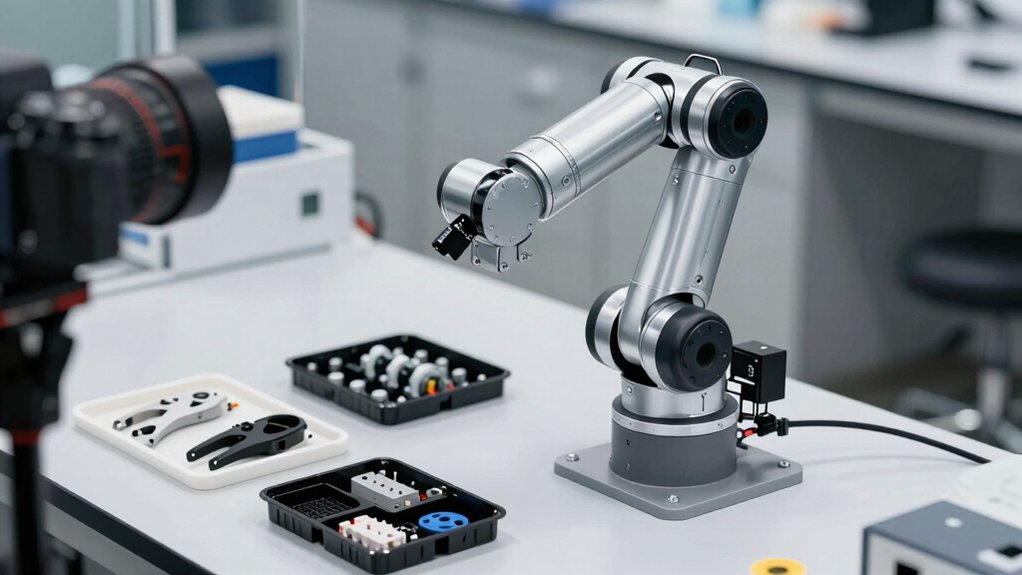
When choosing robotic arm kits, start by evaluating build material quality, noting durability and finish, then compare motor and power needs to ensure you have reliable actuation and appropriate battery or power supply options. Check compatibility and tech by confirming connector types, software support, and available tutorials or SDKs, so you can integrate with your existing tools. Finally, consider learning value, age and safety, selecting options with clear instructions, age-appropriate safety features, and scalable projects that offer practical steps and concrete examples.
Build Material Quality
Begin by evaluating frame materials for strength and safety. Look for durable construction materials like ABS plastic, aluminum alloys, and nylon cables, since they influence longevity and wear resistance during repeated movements. Check if components use metal gears or reinforced joints to support higher torque and reduce gear slip over extended use. Prefer kits with sturdy, non-toxic wood or high-grade plastics for safer handling and lasting structural integrity. Assess build accuracy and fit of parts, focusing on tight tolerances and clean 3D-printed or injection-molded components to ensure smooth articulation. Consider modular, replaceable parts for easy maintenance and future upgrades, such as screws, springs, and actuators, which simplify repairs and enable simple part swaps when needed.
Motor & Power Needs
To choose the right motor and power setup, start by locating clear power specifications on the kit listing—look for integrated power sources, battery boxes, or labeled motor specs to confirm actuation torque and run time. Check if the kit includes an internal Li-ion pack or a hydraulic/pneumatic system, and compare run times under typical loads. Compare motor counts (for example, 4 M motors) and axis capabilities to estimate degrees of freedom and multi-axis reach. Note whether the kit uses non-battery power like manual hydraulics or cable-driven systems for learning environments where reliability matters. Verify clamping details, such as 270-degree claw motion or 180-degree wrist rotation, to gauge grabbing range. Assess external power needs and battery compatibility for remote or programmable control.
Compatibility & Tech
– Start by confirming compatibility with your preferred control interfaces and ecosystems, such as ROS, Python SDKs, or Arduino, so software integration runs smoothly.
Check the number of axes and joints to match your tasks; note 4DOF, 5DOF, or 7-axis configurations, and verify gripper, rotation, and 3D positioning capabilities.
Review power needs, including batteries, hydraulics, or cable-driven systems, and assess how setup, maintenance, and portability are affected.
Evaluate communication options like remote control, Bluetooth, USB, or networked ROS for real-time control and data exchange.
Assess hardware extensibility; confirm compatibility with sensors, cameras, and learning platforms such as 3D depth cameras or AI/IM frameworks for advanced experiments.
Document supported software tools and update paths to ensure long-term compatibility.
Learning Value
When choosing a robotic arm kit, start by identifying the learning outcomes the kit claims, such as problem-solving, physics concepts, or programming basics, and confirm these align with your goals. Look for explicit STEM goals stated on the product page and compare them to your objectives. Favor kits that include hands-on assembly and real-world mechanisms, like hydraulics, 3D perception, or servo-controlled motion, to deepen understanding through practice. Check if the kit provides programming tutorials or open-source software support (ROS, Arduino, Python SDK) to sustain learning and computational thinking. Consider multi-axis or 4DOF/5DOF capabilities, as higher DOFs enable more complex experiments. Review learning durations or time estimates (e.g., 3–5 hours to assemble) to match your schedule.
Age & Safety
Age & Safety: Start by checking the manufacturer-recommended age to guarantee the kit matches the user’s developmental level. Verify you select a model labeled for your age group, such as 8+ or 17+, to ensure appropriate safety and learning pace. Confirm presence of child-safe materials and non-toxic components as a core safety consideration for younger users. Consider whether the kit requires batteries and review battery handling and charging safety, including proper storage and unplugging when not in use. Look for designs that are ambidextrous or have simple, forgiving controls to reduce frustration and enhance safe use for beginners. Review any provided warranty or safety documentation to confirm coverage if components or mechanisms fail during use.
Expansion Potential
Expansion potential should be evaluated upfront to ensure your kit grows with your needs. Begin by checking modular upgrades, such as add-on sensors, extra actuators, or compatible third-party components that extend hardware capabilities over time. Next, verify control software and APIs, like ROS compatibility or a Python SDK, to ensure new tools, algorithms, or motion-planning methods can be integrated as the system expands. Prioritize open-ended hardware architectures with multiple joints, 6-DOF or more, and documented wiring schemes to accommodate additional motors or grippers. Assess power and communication infrastructure, including battery capacity, motor drive capacity, and robust USB/serial interfaces, to prevent bottlenecks. Finally, consider ecosystems offering future expansion kits, extra grippers, or learning modules to progressively increase complexity and capability.
Final Thoughts
To choose, list your goals: basic learning, hydraulics, Arduino integration, or ROS capability. Start with a 784Pcs kit for hands-on block building, then consider a 3-in-1 hydraulic kit to explore fluid power, or Hydrobot for six-axis control. For coding and perception, pick AI Robotic Arm Kit with ROS, or Robot Arm for Arduino for memory and repeat actions. Compare price, compatibility, and project goals, then select the kit that covers your top three priorities.

Meet Ry, “TechGuru,” a 36-year-old technology enthusiast with a deep passion for tech innovations. With extensive experience, he specializes in gaming hardware and software, and has expertise in gadgets, custom PCs, and audio.
Besides writing about tech and reviewing new products, he enjoys traveling, hiking, and photography. Committed to keeping up with the latest industry trends, he aims to guide readers in making informed tech decisions.